Why Drip Coffee Machines Require Precise Medium Grind Particle Distribution
You need a precise medium grind for your drip coffee machine because it guarantees even water flow and balanced extraction. Too many fines cause bitterness; too many boulders lead to weak, sour coffee. A uniform, table salt-like texture lets water move consistently through the grounds. Blade grinders won’t cut it-use a burr grinder like the Baratza Encore or 1Zpresso JX-Pro. Get the grind right, and you’ll pull out the best flavors every time-here’s how to fine-tune it.
Notable Insights
- A precise medium grind ensures optimal extraction during the 4–6 minute brew cycle of drip machines.
- Uniform particle size prevents over-extraction from fines and under-extraction from boulders.
- Consistent grind texture like table salt promotes even water flow and minimizes channeling.
- Medium grind balances contact time and flow rate for clarity, sweetness, and complexity.
- Burr grinders provide the particle uniformity needed to avoid bitterness and weak, sour flavors.
Why Grind Size Makes or Breaks Drip Coffee
While it might seem small, grind size plays a critical role in how your drip coffee turns out, directly affecting flavor, strength, and overall quality. If your grind is too fine, water temperature interacts too aggressively, leading to over-extraction and bitterness, especially if brew time extends too long. Too coarse, and water rushes through too quickly, yielding weak, under-extracted coffee, even with ideal temperature around 195–205°F. A medium grind matches most drip machines, balancing contact time and flow rate. You want grounds resembling table salt-consistent and uniform. That helps water extract evenly within the typical 4-6 minute brew window. Mess with the grind, and you disrupt this balance, making temperature and brew time less effective. A burr grinder gives you control, unlike blade grinders, which create uneven particles. Adjusting grind size is the fastest way to fix taste issues-easier than changing your machine or water setup. For optimal results, consider investing in one of the best coffee and espresso grinders that deliver consistent medium grind particle distribution.
Fines and Boulders: How Inconsistent Grind Ruins Extraction
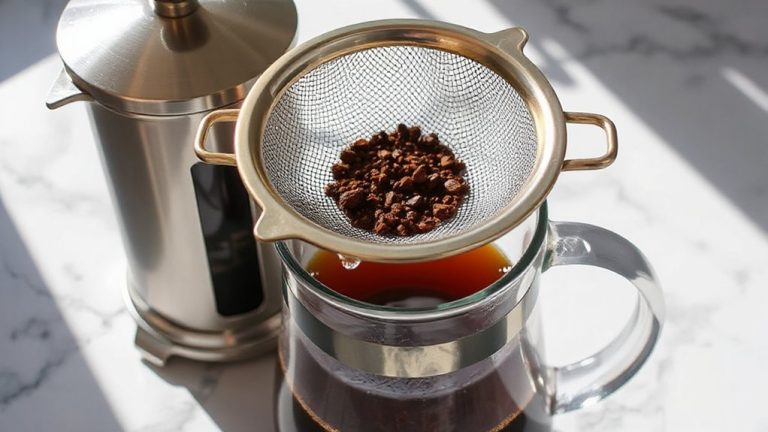
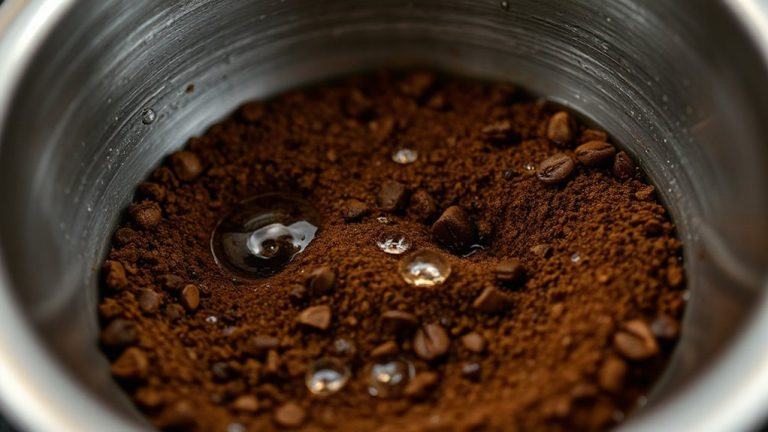
Fines and boulders-the tiny, dust-like particles and oversized chunks that come with uneven grinding-sabotage your coffee’s flavor before the brewing even starts. You get sour, weak coffee because boulders under-extract while fines over-extract, creating imbalance. During brewing, fines clump and restrict water movement, disrupting turbulence flow and slowing down extraction where it shouldn’t. Meanwhile, boulders leave gaps, encouraging channel formation-where water carves paths through the loose spots, bypassing most grounds. This means some parts of your coffee bed extract poorly while others turn bitter. Inconsistent particle size prevents even saturation and steady flow, which drip machines rely on. Even a decent grinder can produce this if it wears down or lacks uniformity. If you’re using a low-end blade grinder, you’re almost guaranteed fines and boulders. Upgrade to a burr grinder for tighter distribution-it’s the most practical fix. For optimal results, consider investing in one of the best grinders for filter coffee that ensure consistent particle size and minimize extraction flaws.
What the Perfect Medium Grind for Drip Looks Like
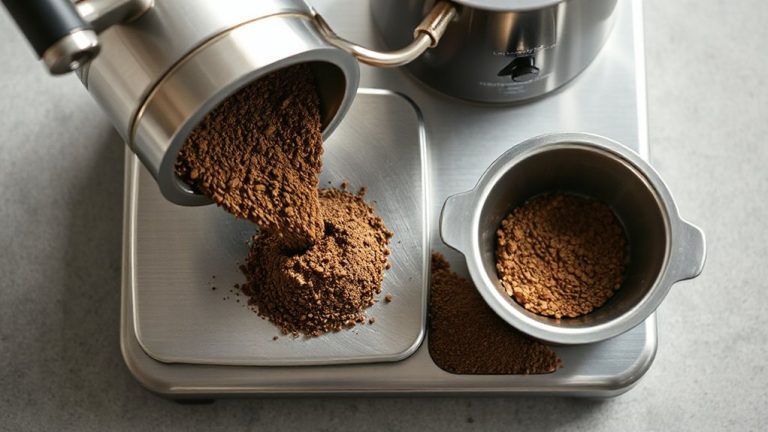
Think of your coffee grounds like a team-when every particle’s the right size, they work together to deliver balanced flavor. For drip brewing, the ideal medium grind has a consistent grind texture, similar to table salt. You need good particle uniformity to guarantee even extraction-too many fines or boulders and your coffee turns bitter or weak. A uniform grind lets water flow evenly, extracting sweetness and complexity without harshness. Investing in a high-quality burr grinder designed for pour-over brewing can significantly improve grind consistency and overall flavor clarity.
| Feature | Ideal for Drip |
|---|---|
| Grind Texture | Like sand, not powder or rocks |
| Particle Uniformity | High-minimal fines or boulders |
This level of consistency avoids clogging or channeling, giving you reliable results cup after cup.
Pick a Grinder for Even Coffee Grounds
Your grinder makes the biggest difference in how evenly your coffee grounds are sized, which directly affects flavor. Blade grinders? Skip them-they create uneven particles that hurt extraction. Instead, use a burr grinder. The burr type matters: flat burrs tend to produce more uniform grounds, while conical burrs are quieter and generate less heat. Both work for drip, but consistency is key. Look for a model with precise settings so you can hit the right medium grind. Calibration frequency is another factor-cheaper burr grinders drift over time, messing up your brew. Mid-range options like the Baratza Encore or 1Zpresso JX-Pro hold calibration longer and offer better particle uniformity. If you’re serious about drip coffee, investing in a solid burr grinder pays off fast. Regular cleaning and monthly checks help maintain performance. It’s not flashy, but it’s the most practical step toward better, more consistent coffee every time.
5 Grind Mistakes That Make Drip Coffee Bitter or Weak
If you’ve ever poured a cup that tasted harsh or underwhelming, the culprit might not be your coffee or machine-it’s likely your grind. Grinding too fine slows extraction, pulling out bitter compounds, especially if your water temperature is ideal (around 195–205°F). That bitterness isn’t from bad beans-it’s over-extraction due to small particles. On the flip side, a coarse grind leads to weak coffee because water zips through without pulling enough flavor. Unlike espresso, drip doesn’t need tamping pressure, but using uneven grounds throws off extraction. Even with perfect water temperature, inconsistent particle size means some bits over-extract while others under-extract. A burr grinder helps avoid this by delivering a uniform medium grind-the sweet spot for drip. Blade grinders often create a mixed particle size, increasing the odds of off-flavors. Choose consistency, skip the tamp, and match your grind to your brewer’s needs.
Test and Adjust Your Drip Coffee Grind at Home
How do you know when your coffee grind is spot-on for drip? You’ll see clean extraction-balanced flavor, no bitterness or weakness. Start by checking brew time: 3–4 minutes is ideal. If it’s too fast, your grind’s too coarse; too slow, it’s too fine. Always use fresh beans-coffee freshness matters because stale grounds dull taste, no matter the grind. Water temperature should stay between 195–205°F; most machines hit this range, but scale buildup can interfere.
Adjust gradually and take notes. Try this grind test:
| Brew Time | Flavor Result | Adjust Grind |
|---|---|---|
| < 3 min | Weak, sour | Finer |
| 3–4 min | Balanced, sweet | Perfect |
| > 4 min | Bitter, over-extracted | Coarser |
| Clumpy | Muddy, dull | Coarser |
| Gritty | Under-extracted | Finer |
On a final note
You need a consistent medium grind for drip coffee because it guarantees even extraction-too fine leads to bitterness, too coarse causes weakness. A good burr grinder like the Baratza Encore or Fellow Ode keeps particles uniform, reducing fines and boulders. Inconsistent grinds create unbalanced flavors, no matter your brewer. Test with water flow: ideal takes 3–4 minutes. Adjust until flavor is clean, balanced, and repeatable. Grind fresh, measure precisely, and tweak as beans change.