Why Rwandan Coffee Is Now a Staple in Nordic Roasting Competitions
You’re roasting Rwandan coffee because its high-altitude farms produce dense beans with bright acidity, ideal for light to medium profiles Nordic judges favor. Direct trade guarantees fresh, traceable lots, while precise wet milling at places like Akagera delivers consistency. Farmers’ focus on quality and fermentation control means clean, vibrant cups with reproducible results-exactly what competition roasters need. Better sugar development and stable harvests make it a reliable choice season after season.
Notable Insights
- High-altitude growth in Rwanda yields dense beans with vibrant acidity, ideal for light to medium roasting preferred in Nordic competitions.
- Direct trade access ensures Nordic roasters receive fresh, high-scoring Rwandan lots with full traceability and consistent quality.
- Rebuilding Rwanda’s coffee sector post-1994 created a modern specialty system focused on quality, consistency, and farmer training.
- Precision wet mill processing in Rwanda ensures clean, uniform beans that behave predictably during roasting and cupping.
- Nordic roasting preferences for electric control, short development, and terroir clarity align perfectly with Rwandan coffee’s profile.
Why Rwandan Coffee Dominates Nordic Competitions
While you might think coffee success in Nordic roasting contests depends mostly on roasting skill, the truth is that Rwandan beans come with built-in advantages that give roasters a head start. Grown at high altitudes with consistent rainfall, these beans develop dense structure and vibrant acidity-ideal for precise roasting. You’ll notice cleaner profiles and better sugar development, especially in light to medium roasts. Plus, Rwanda’s minimal climate impact means more stable harvests and predictable bean quality year after year. Favorable trade policies also help: direct trade access and low tariffs make it easier and cheaper for Nordic roasters to source fresh, high-scoring lots. Unlike beans from regions with volatile supply chains, Rwandan coffee arrives with traceability and freshness intact. That reliability lets you focus on technique, not troubleshooting inconsistency. When every second counts in competition, these factors aren’t just helpful-they’re decisive.
How Rwanda Built a Specialty Coffee Pipeline
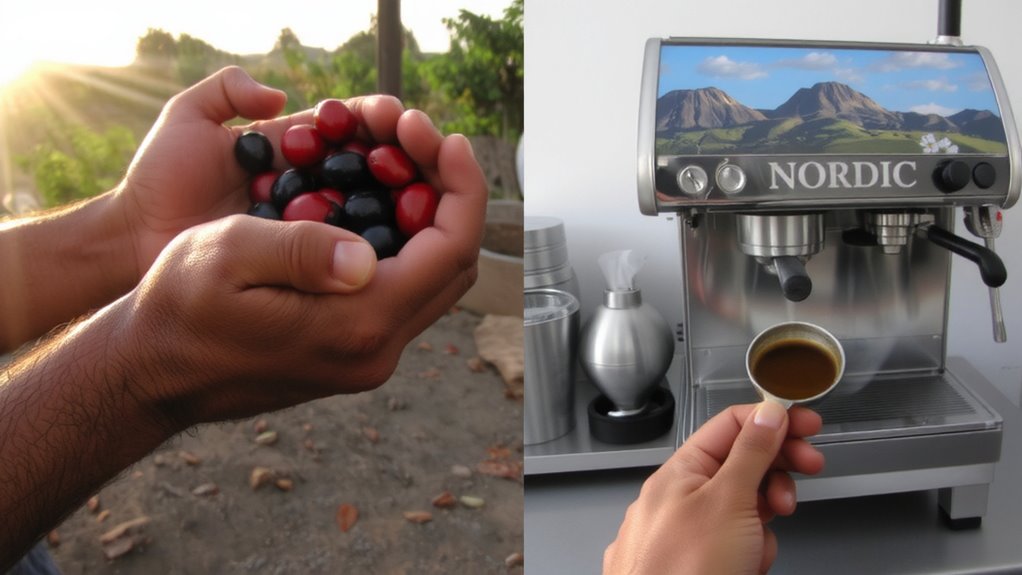
Because Rwanda’s coffee industry was rebuilding from the 1994 genocide, it had the rare chance to design a specialty pipeline from the ground up-with support from international aid, research-driven farming programs, and a national push for quality. You see the results in well-structured supply chains that prioritize consistency and traceability. Farmer training programs helped smallholders adopt precise harvesting and fermentation techniques, directly improving bean quality. These efforts made Rwanda a reliable source for specialty-grade coffee. Direct trade networks then connected cooperatives and washing stations to roasters abroad, cutting out middlemen and ensuring better prices for farmers. This model benefits everyone: you get fresher, well-documented beans, while producers gain stable income. Unlike older coffee regions with fragmented systems, Rwanda built its pipeline with modern quality control from the start-so when you brew a Rwandan coffee, you’re tasting a system designed for excellence, not just luck.
Bright Acidity and Fruit Notes in Rwandan Beans
Rwanda’s deliberate approach to building a specialty coffee system shows up clearly in the cup-especially in the bright acidity and fruit-forward profiles that stand out in Nordic roasting competitions. You’ll notice these beans often deliver a crisp, lively snap on the tongue, not harsh but cleanly tart, like biting into a green apple. That acidity carries distinct fruit notes-think ripe red berries or stone fruit-enhanced during careful roasting that preserves delicate compounds. When brewed as a pour-over, you’ll catch a subtle floral aroma, sometimes leaning into jasmine or bergamot, depending on the lot. The finish often brightens further, revealing a citrus finish that lingers without bitterness. These traits don’t come by accident; they result from precise farming and post-harvest control. For roasters, this consistency means predictability in competition-fewer surprises, more room to highlight clarity and balance without over-roasting.
How Wet Mills Shape Competition-Ready Beans
A well-run wet mill can make or break a coffee’s shot at a podium finish, and in Rwanda, these facilities are where beans earn their competition edge. You’re not just washing coffee here-you’re shaping quality with precision. Modern mills like Akagera or Gashonga use calibrated depulpers and fermentation tanks to guarantee consistent bean density, which roasters need for even heat response. Fermentation control is critical: too long and the cup turns woody; too short and you lose brightness. Most top Rwandan mills now time this step to the hour, using pH monitoring and cool, clean water. After fermentation, careful washing and raised-bed drying further protect bean integrity. The result? Dense, uniformly processed beans that crack predictably under roasting stress. These are the ones that shine in Nordic competitions-clean, vibrant, and structurally sound from the first crack to the final cup evaluation. Your roast profile stands or falls on this foundation.
How Nordic Roasters Highlight Rwandan Terroir
You’ve got clean, dense beans from well-managed Rwandan wet mills-now it’s time to roast them with intent. Nordic roasters often use electric roasters like the Aillio Bullet or Probat sample roasters for precision. You’ll want a profile that’s gentle early, preserving the bright acidity typical of Rwandan high-altitude beans. A steady ramp to first crack brings out the stone fruit notes-think ripe peach or apricot-without tipping into bitterness. Too much heat too fast kills the delicate floral aroma. Instead, finish with a short development time, around 15% of total roast. Roast too dark and you lose terroir clarity. Light to medium roasts highlight origin character best, especially for washed beans. You’re not chasing body here-you’re showcasing nuance. Adjust airflow to stabilize heat transfer, and expect longer roasts, often 9–11 minutes. It’s not dramatic-it’s disciplined, repeatable, and focused on what the bean already has.
What Judges Reward in Nordic Roasting Contests
While precision matters in Nordic roasting contests, it’s consistency and transparency that really catch the judges’ attention. You’re judged not just on flavor, but on how reliably you replicate your roast across batches. Judges use strict scoring criteria focusing on balance, acidity, and aftertaste, all evaluated through blind tasting to remove bias. Your roast log must match your results-fudging notes is a fast way to lose credibility. They’ll look for clarity in the cup, with clean profiles that let Rwandan coffee’s natural bright berry and citrus notes shine. Over-roasting to mask defects won’t fly; neither will erratic development times. Use a roaster with stable drum speed and airflow control, like a Probat or Gene Café, to maintain repeatability. Ultimately, your goal is a roast that’s not only tasty but verifiable, traceable, and reproducible under pressure.
How Cooperatives Ensure Consistent Champion Lots
Because quality starts long before the roaster, Rwandan cooperatives build consistency from the ground up by standardizing every step after harvest. You’ll find that each cherry is floated, depulped, fermented, washed, and dried to precise standards-whether at a centralized wet mill or a smallholder’s plot. Cooperatives use quality tracking systems to log data at each stage, so flaws are caught early and methods adjusted. When lots score high, farmer incentives kick in: cash bonuses, better prices, or input support, which motivates sustained care. These rewards aren’t handed out randomly-they’re tied directly to traceable results. In practice, this means you’re more likely to source beans that perform predictably in roasting, cupping, and extraction. Unlike unorganized farming, where conditions vary wildly, cooperative-led production reduces risk. The result? Repeatable champion lots that Nordic judges recognize year after year. It’s not magic-it’s method.
On a final note
You’ll find Rwandan beans in Nordic roasting contests because they offer clean, bright acidity and distinct fruit notes-traits judges favor. Their wet-processed lots are consistent, thanks to strong cooperatives and meticulous milling. When roasting, highlight the terroir with a even development profile; avoid over-roasting to preserve clarity. For best results, use a roaster with precise temperature control like a Loring or Probat, and always record your batches for repeatability.