A Guide to Fine-Tuning Extraction Speeds for Enhanced Flavor Intensity in Pour Over Brewing
You control extraction speed with your grind, pour, and ratio-key to accessing flavor intensity. A finer grind slows flow, boosting extraction; go too coarse and your coffee turns weak and fast. Keep water between 195°F–205°F-use a gooseneck like the Fellow Stagg for precision. Pour in spirals with pauses to avoid channeling. Adjust dose or filter type if your brew’s too quick or slow. Small tweaks make big differences. Next steps reveal how to fine-tune each variable for balance.
Notable Insights
- Adjust grind size to control extraction speed: finer for slower extraction, coarser for faster flow and reduced bitterness or sourness.
- Maintain water temperature between 195°F–205°F to optimize solubility and achieve balanced flavor intensity without over- or under-extraction.
- Use a gooseneck kettle to improve pour control, enabling precise flow rate and even saturation for consistent extraction.
- Modify coffee-to-water ratio to influence bed density; higher doses slow extraction and increase flavor strength in the final cup.
- Apply spiral or pulse pouring techniques to prevent channeling and regulate brew time for enhanced flavor clarity and symmetry.
Why Extraction Speed Makes or Breaks Your Pour Over
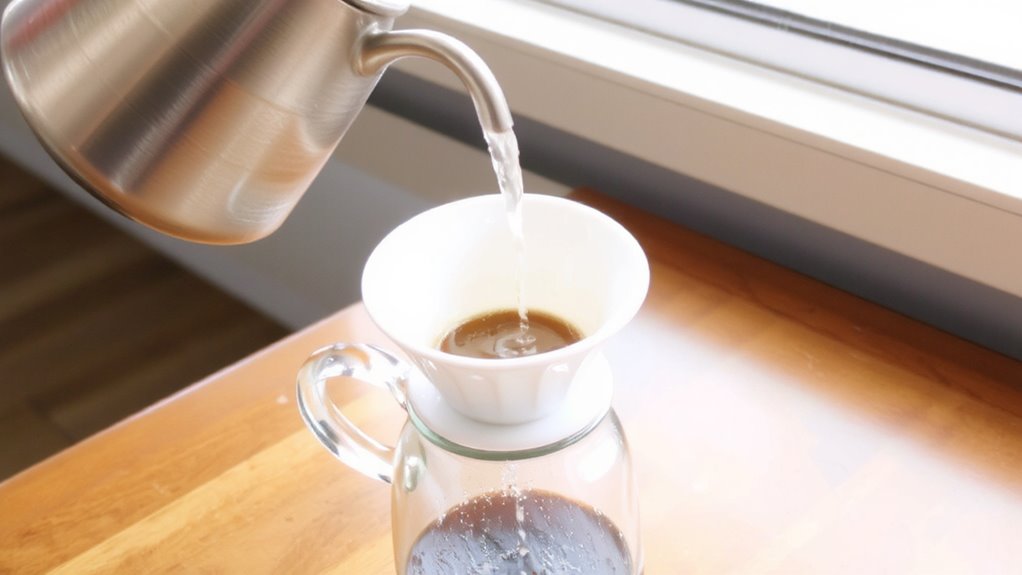
Even if you’re using fresh beans and clean water, your pour over can still miss the mark if extraction speed isn’t dialed in properly. Too fast, and you’ll under-extract-your coffee tastes sour, thin, and unbalanced. Too slow, and it becomes bitter or harsh from over-extraction. The sweet spot delivers even brew symmetry, where water moves consistently through the coffee bed, extracting compounds evenly. This consistency is key to achieving flavor balance-brightness, sweetness, and body in harmony. Manual kettles like the Fellow Stagg EKG help control pour rate, improving repeatability. Paper filters, such as Hario’s #2, promote cleaner, more controlled flow versus metal. Your gooseneck kettle, brew vessel, and pouring technique all influence timing. Aim for total brew times between 2:30 and 3:30 minutes, adjusting variables until clarity and balance emerge. Precision here beats guesswork every time. For consistent results, consider using one of the best pour-over coffee makers recommended for optimal control and performance.
How Grind Size Changes Your Brew Time and Flavor
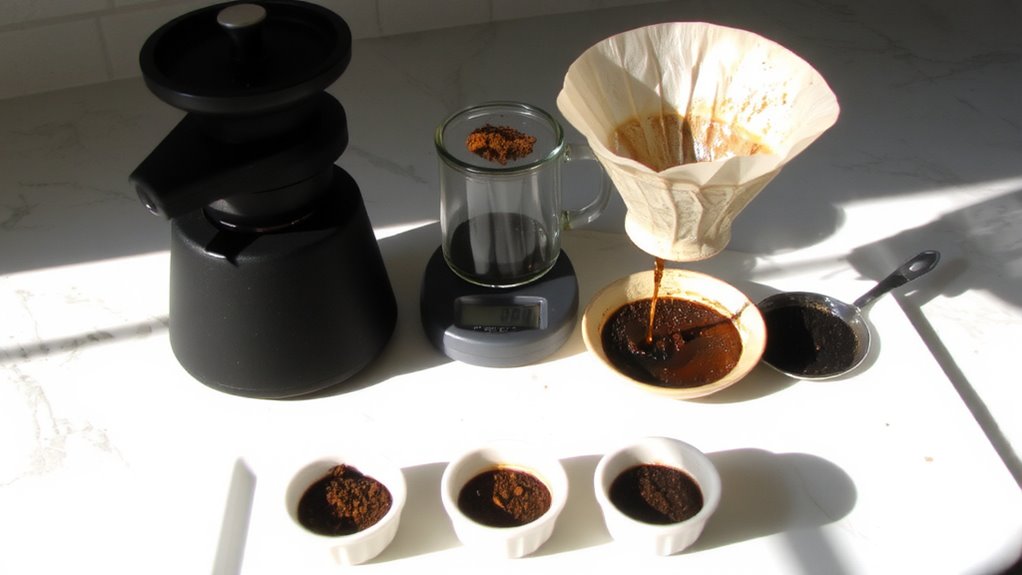
A finer grind slows water flow through the coffee bed, increasing brew time and boosting extraction, while a coarser grind speeds things up, reducing contact time and potentially leading to underdeveloped flavors. Your grind size directly controls how much flavor you pull-too fine and you risk bitterness, too coarse and your brew tastes weak or sour. For best results, aim for consistent grind uniformity; uneven particle distribution creates mixed extraction, with some bits over-extracting while others under-extract. Blade grinders often produce poor particle distribution, so a burr grinder-like the Baratza Encore or 1ZPresso Q2-is a smarter choice. Adjusting grind size lets you fine-tune flavor without changing your pour technique. Small changes make noticeable differences. Always check that your grind matches your brew time target-roughly 2:30 to 3:30 minutes-and tweak from there.
Water Temperature’s Impact on Extraction Speed
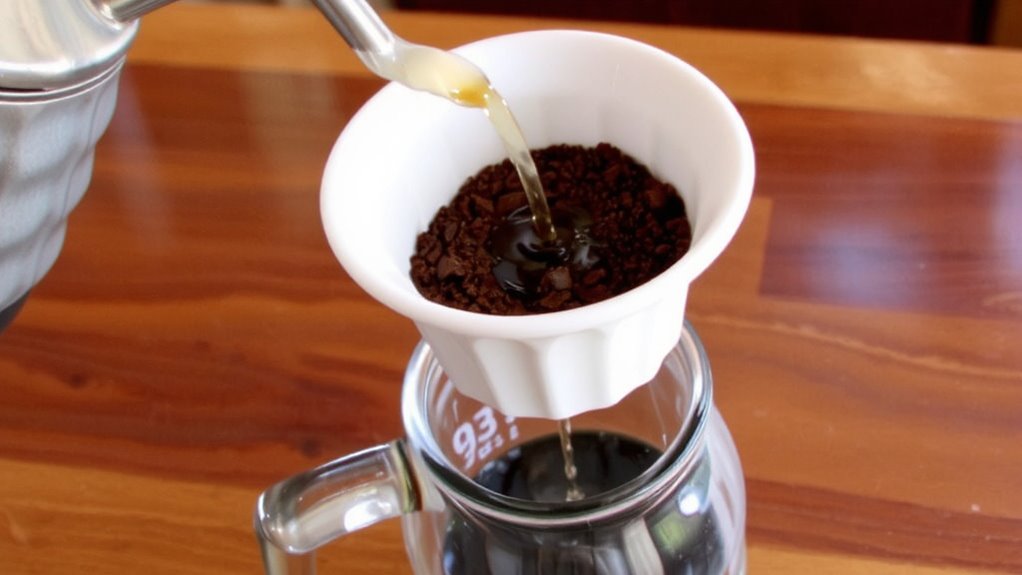
You’ve already seen how grind size shapes extraction by controlling water flow and contact time, but temperature plays just as direct a role in how quickly flavors pull from the coffee. Hotter water increases water solubility, pulling compounds faster-great for under-extracted, flat brews. But go too high, and you risk thermal degradation, scorching delicate notes and boosting bitterness. Most specialty roasters recommend 195°F–205°F as a sweet spot for balanced intensity. For more precision in both temperature and pour control, consider using a gooseneck kettle with variable temperature settings, such as those highlighted in the Best gooseneck kettles roundup.
| Temperature | Effect on Extraction |
|---|---|
| 195°F–205°F | Ideal solubility, even flavor |
| Below 195°F | Slower extraction, may taste weak |
| Above 205°F | Risk of thermal degradation, bitterness |
Stick to an electric kettle with temp control-like the Fellow Stag or Bonavita variable kettle-for precision. Adjust within this range to match roast level: lighter roasts often like the higher end, darker roasts the lower.
How Pouring Technique Controls Flow Rate
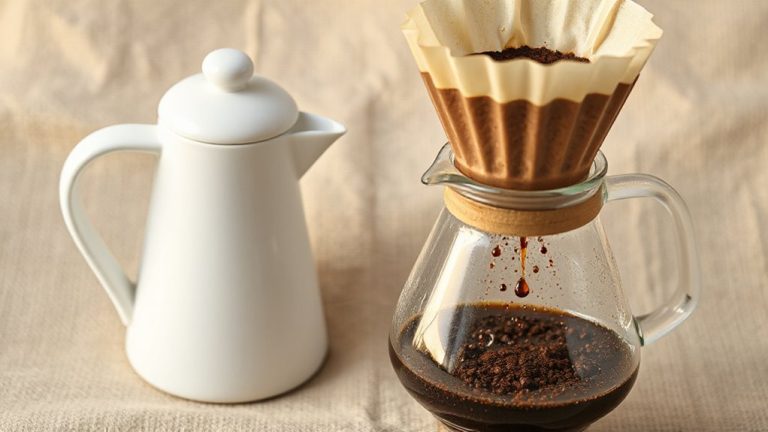
The way you pour determines how evenly water moves through the coffee bed, directly shaping flow rate and extraction consistency. Using spiral pouring, you spread water evenly from center to edge and back, promoting uniform saturation, which helps prevent channeling and keeps flow steady. It’s ideal for most pour overs like the Hario V60. Pulse pouring, adding water in intervals, gives you more control-pausing lets the bed settle and slows overall flow. This method works well for medium to coarse grinds, helping avoid over-extraction. Fast, continuous pours speed up drainage and risk under-extraction; too-slow pouring can over-extract and clog flow. Your pouring rhythm directly affects brew time and flavor balance. Practicing consistent spiral or pulse techniques lets you fine-tune extraction without changing grind size. A gooseneck kettle helps, since it offers precision. Focus on controlled, repeatable motions to improve results.
How Coffee-to-Water Ratio Changes Brew Speed
While it might not seem obvious at first, changing your coffee-to-water ratio directly affects how fast water moves through the grounds. Using more coffee slows the flow because the bed becomes denser, restricting movement. A finer grind isn’t the only factor-your ratio sets the foundation. With a higher coffee dose, water takes longer to pass, especially in conical brew vessels like the Hario V60, where space is tight. Wider vessels like the Chemex handle larger amounts better, but only to a point. The filter paper type also plays a role-thicker papers like Chemex’s branded filters slow flow further, compounding the delay from high coffee ratios. Thinner papers, like those from Able, let water move faster, helping balance a strong coffee-to-water mix. Keep this in mind when adjusting ratios-it’s not just strength you’re changing, but speed. For precise control over this balance, consider using one of the best coffee ratio tools to ensure consistency and accuracy.
Fixing Fast or Slow Pour Over Brews
When your brew runs too fast or drags too slow, it’s usually a sign something’s off in your setup. If water passes through in under two minutes, your grind is likely too coarse or your dose too low-refine the grind or increase coffee slightly. A brew over four minutes? Your grind may be too fine or the filter clogged. Check your bloom consistency; uneven blooming can stall water flow, especially with a dense bed. Switching filter type can help-bleached paper filters flow faster than unbleached ones, while metal filters drastically speed things up but risk over-extraction or sediment. V60s favor speed; Kalitas promote even flow. Adjust one variable at a time. A stable bloom and consistent pour matter as much as the gear. Match your filter type to your desired pace and watch how it influences extraction.
A Step-by-Step Routine for Perfect Pour Over Every Time
Start by choosing your pour over device-V60, Kalita Wave, or Chemex-each shapes flow rate and extraction differently. Use freshly ground beans, medium-coarse like sea salt, and pre-wet your filter to remove paper taste and stabilize temperature. Add coffee, then begin bloom: pour twice the weight of water to grounds and wait. Aim for a 30–45 second bloom duration to let gases escape and guarantee even saturation. Gently stir to control agitation level-too much causes over-extraction, too little leads to uneven brew. After blooming, pour in steady spirals, keeping water level consistent. Total brew time should be 2:30–3:30, depending on your device. V60s drain faster, needing attention to pour speed; Kalita Waves offer more forgiveness. Adjust grind or pour technique if it’s too fast or slow. Practice makes consistent results.
On a final note
You now control the key factors that shape your pour over’s flavor. Adjust grind size, water temperature, pouring technique, and coffee-to-water ratio to fine-tune extraction speed. If the brew runs too fast, go finer or use more coffee. If too slow, go coarser or adjust your pour. Small changes make a noticeable difference. Use a scale, kettle with gooseneck, and burr grinder for consistency.