How Grind Size Selection Impacts French Press Flavor Profile: An In-Depth Analysis
Your grind size directly shapes your French press coffee’s flavor. Too fine, and you get bitter, over-extracted sludge from tannins and tiny particles sneaking through. Too coarse, and the brew’s weak, thin, and under-extracted since water zips through. Aim for medium-coarse-like rough sand-using a burr grinder like the Baratza Encore for even particles. This balances extraction, preserving body and clarity. Pair with 195–205°F water and a 4-minute steep. Dark roasts may need a touch coarser; light roasts benefit from even consistency. A blade grinder creates uneven chunks and powder, muddling flavor. Metal filters maintain oil and richness better than paper. Get the grind right, and you’ll taste the full, intended profile-explore further to fine-tune each variable.
Notable Insights
- A coarse grind prevents over-extraction, reducing bitterness and minimizing sludge in the cup.
- Uniform grind size from a burr grinder ensures balanced flavor by promoting even extraction.
- Too fine a grind increases tannin extraction, leading to harsh, bitter coffee and excessive sediment.
- Too coarse a grind yields under-extracted, weak coffee with hollow, thin flavor despite proper steep time.
- Medium-coarse grind, like rough sand, optimizes extraction for full body, clarity, and aromatic complexity.
Why Grind Size Is Critical for French Press
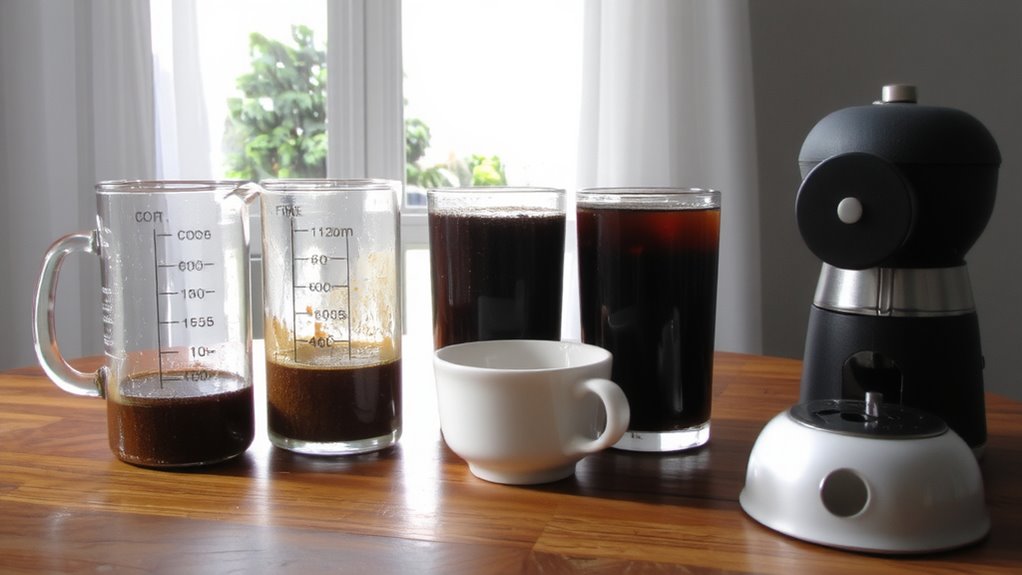
While it might seem like a small detail, getting the grind size right is essential for a good French press brew. You need a coarse grind to prevent sludge and over-extraction, but it’s not just about size-grind uniformity matters too. Uneven particle distribution means some grounds extract too fast while others don’t extract enough, leading to off-flavors. A consistent grind guarantees even extraction and balanced flavor. Blade grinders often create inconsistent particle distribution, so a burr grinder like the Baratza Encore is a better choice. Your French press should brew for about four minutes, and without proper grind uniformity, timing won’t save you. Too many fines or boulders disrupt the entire process. Aim for grounds resembling rough sand, not powder or pebbles. It’s not just preference-it’s how the brew method works best. Get the grind right, and your coffee improves immediately. For those seeking top-tier consistency, investing in one of the best burr grinders can make a significant difference in your daily brew.
Grind Too Fine? You’ll Get Bitter Coffee
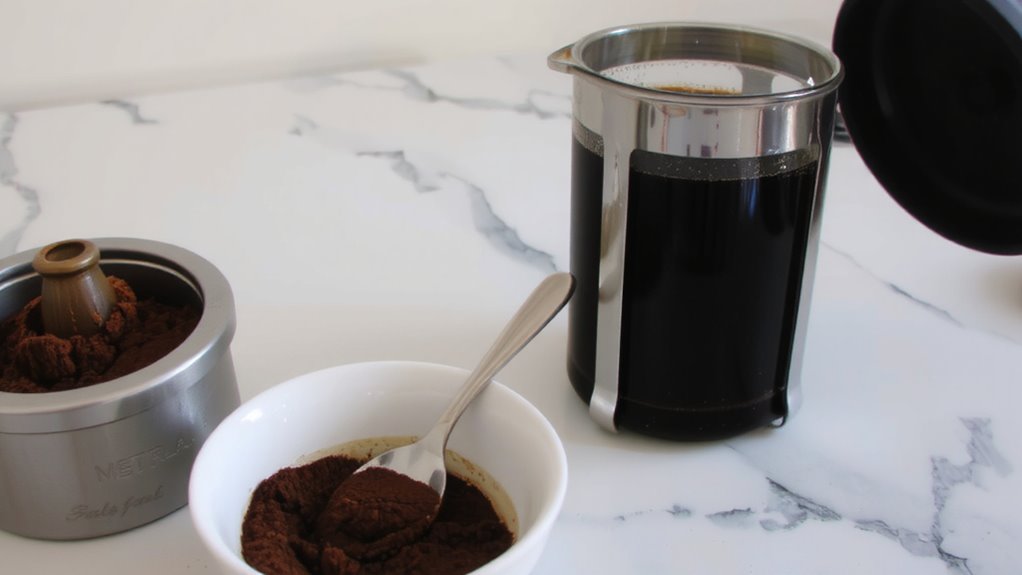
Why does your French press coffee sometimes taste harsh or bitter? You’re likely grinding too fine. When particles are too small, they over-extract during the four-minute steep, increasing over extraction risks. That means more tannins and bitter compounds dissolve into your cup. A burr grinder set too tight-like one mimicking espresso grind-creates this problem fast. You’ll also notice more sediment buildup at the bottom of your cup, as fine grounds slip through the press filter. This isn’t just unpleasant to sip-it’s a sign of poor control. For cleaner, smoother coffee, aim for a consistent, coarse grind, similar to sea salt. Brands like Baratza Encore let you adjust precisely to avoid this. Remember: finer doesn’t mean stronger. It often just means bitter. Adjust your grind, and you’ll balance flavor fast. Some enthusiasts achieve optimal extraction by using a slow drip coffee maker for a cleaner, sediment-free cup with nuanced flavor.
Too Coarse? Your Coffee Will Be Weak
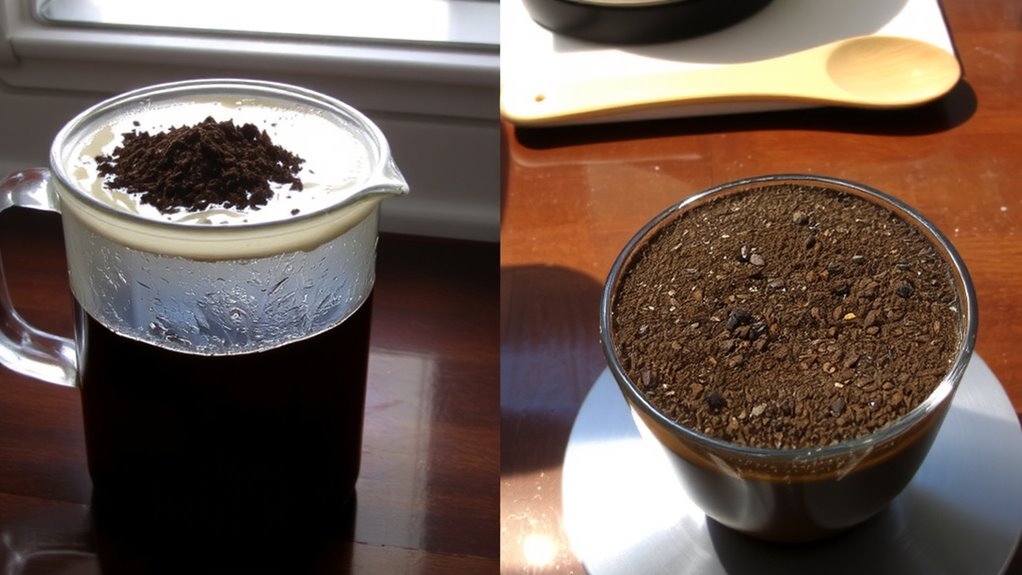
Going too far in the opposite direction and using a grind that’s too coarse brings its own problems. You’ll face under extraction risks, where water passes through too quickly, failing to pull enough flavor. This leads to a weak brew causes frustration-you’re left with a watery, hollow cup lacking body or richness. Coarse grounds reduce surface area, so even with a full four-minute steep, you miss out on sugars and aromatics. Below is a quick comparison of grind effects:
| Grind Size | Extraction Risk | Brew Strength |
|---|---|---|
| Too Coarse | High under extraction risks | Weak brew causes thin taste |
| Ideal | Balanced extraction | Full, rich flavor |
| Too Fine | Over-extraction | Bitter, harsh results |
Stick to a consistent burr grinder to avoid weak brew causes from uneven particles.
The Perfect Grind Size for French Press
The best grind size for a French Press is medium-coarse, about as fine as rough sand or breadcrumbs. This grind allows ideal extraction without over-pulling bitter compounds or letting fine sediment slip through. If your coffee tastes flat, it might not just be the grind-consider the roast level and coffee origin too. Dark roasts, which extract faster, can handle a slightly coarser grind, while light roasts often benefit from even extraction that this grind size supports. Beans from Ethiopia, with delicate floral notes, stay balanced, while Sumatran coffees maintain their earthy depth. Too fine, and you’ll get muddiness; too coarse, and you’ll miss clarity. Adjust only slightly based on these factors-your grind should stay in the medium-coarse zone. Consistency matters, but we’ll cover that next. For now, stick with this standard to highlight flavor without sludge or weakness.
Burr vs. Blade: Which Gives Consistent Grind?
While you might be tempted to grab whatever grinder is handy, choosing between burr and blade models makes a real difference in how evenly your coffee grounds turn out. Burr grinders crush beans between two ridged plates, giving you a uniform grind size-critical for balanced French press extraction. They do cost more, but the consistency pays off. Blade grinders, on the other hand, chop beans with a spinning blade, creating uneven particles that lead to bitter and weak flavors. You’ll also deal with more grind noise and inconsistent results. Plus, over time, blade wear worsens this unevenness, making it harder to get a repeatable grind. While blade grinders are cheaper and compact, their flaws show in the cup. For serious French press brewing, a burr grinder like the Baratza Encore or even a hand grinder like the Hario Skerton Pro offers better control and consistency-critical for a clean, rich brew. According to Wirecutter’s comprehensive testing, the best coffee grinders deliver precisely the uniformity needed for optimal French press results.
How Temp and Time Change Grind Results
Since coffee extraction depends on surface area, the size of your grounds directly affects how quickly flavor compounds dissolve-and that’s where timing and water temperature come into play. If your water’s too hot, say above 205°F, you risk over-extracting, especially with fine grinds, leading to bitterness. Too cool, below 195°F, and under-extraction dulls the flavor. Water stability matters: a gooseneck kettle or temperature-controlled brewer helps maintain that sweet spot. Coarser grinds need longer time-closer to 4–5 minutes-to hit extraction peaks without turning harsh. Fine grinds extract faster, so even 3 minutes can push past ideal. Always adjust time based on grind: a few seconds can mean the difference between balance and imbalance. Your French press doesn’t forgive slop-consistent temp and precise timing sharpen results. Use a timer and thermometer; they’re cheap and effective tools.
Why Your French Press Tastes Bad (And How to Fix It)
If your French press coffee tastes bitter, sour, or flat, chances are it’s not the beans-it’s how you’re brewing. Using too fine a grind leads to overextraction issues, where bitter compounds dominate. Go coarse-like sea salt-for balanced flavor. If your brew’s sour, the grind might be too coarse or steep time too short; adjust to 4 minutes. Water temp matters too: aim for just off-boil, around 200°F. Avoid paper filter use here; the metal screen is essential for oil and body. Paper filters trap those rich compounds, making coffee taste thin. Stick with the built-in filter and clean it well after each use. Always use fresh beans and grind right before brewing. Scale your dose: 1:15 coffee to water ratio works well. These tweaks fix most off-flavors and dramatically improve your cup without extra gear.
On a final note
You need a coarse, even grind for French press to avoid bitterness or weak coffee. A burr grinder gives consistent results, while blade grinders often create uneven particles. Water temperature and steep time-around 200°F and 4 minutes-also affect flavor. If your brew tastes bad, check these factors first. Adjusting grind size is the quickest fix. Use it to fine-tune strength and clarity in every cup.