Understanding the Art of Pour Over Coffee Techniques and Variations
You control the pour over process by adjusting grind size, water temperature, and brewing gear to bring out your coffee’s best flavors. Use a gooseneck kettle and scale for precision. A burr grinder guarantees even particles. Match your grind to the brewer-V60 for brightness, Chemex for smoothness. Rinse the filter, use fresh beans, and keep water between 195°F and 205°F. There’s more to learn about refining each step.
Notable Insights
- Choose the right brewer shape, like the V60 for bright flavors or Chemex for smooth body, to match your taste preference.
- Use a gooseneck kettle to control water flow and ensure even saturation during the pour.
- Grind coffee to medium-fine consistency with a burr grinder for uniform extraction and balanced flavor.
- Maintain water temperature between 195°F and 205°F to avoid under- or over-extraction.
- Adjust grind size and pour technique based on dripper geometry for optimal flavor in each brew.
Brew the Perfect Pour Over: Step-by-Step Guide
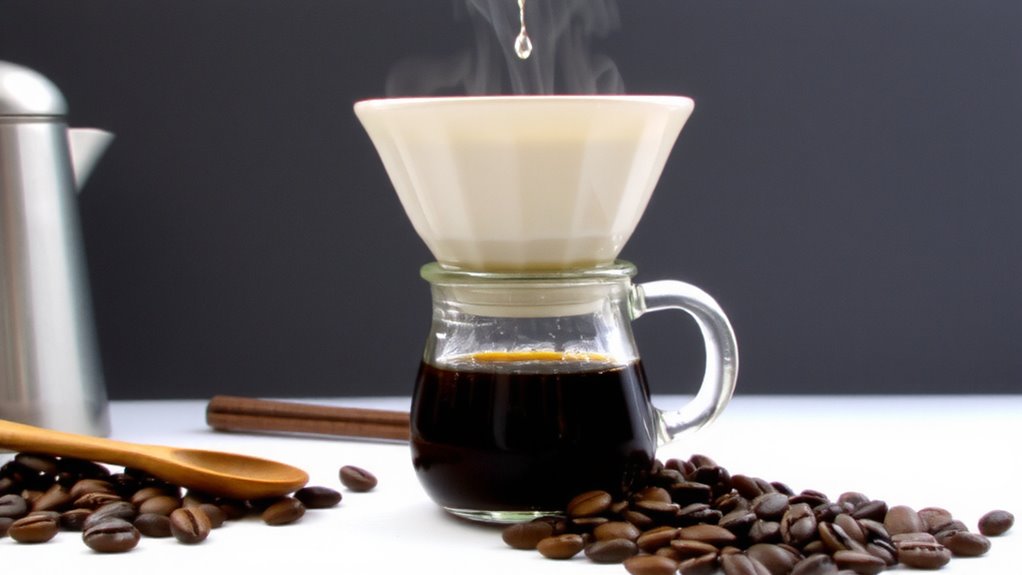
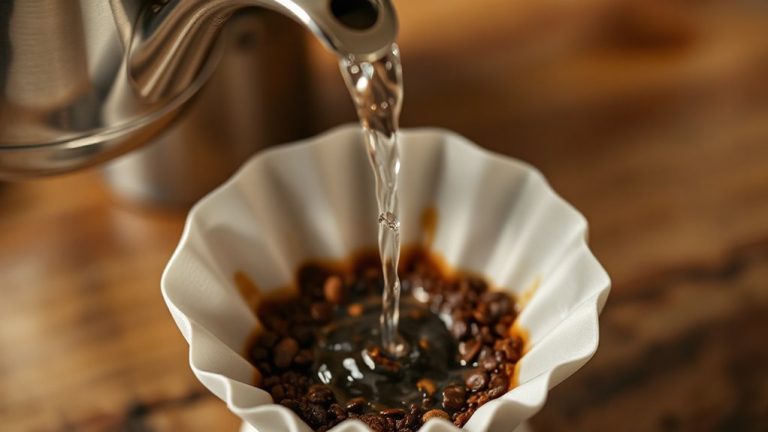
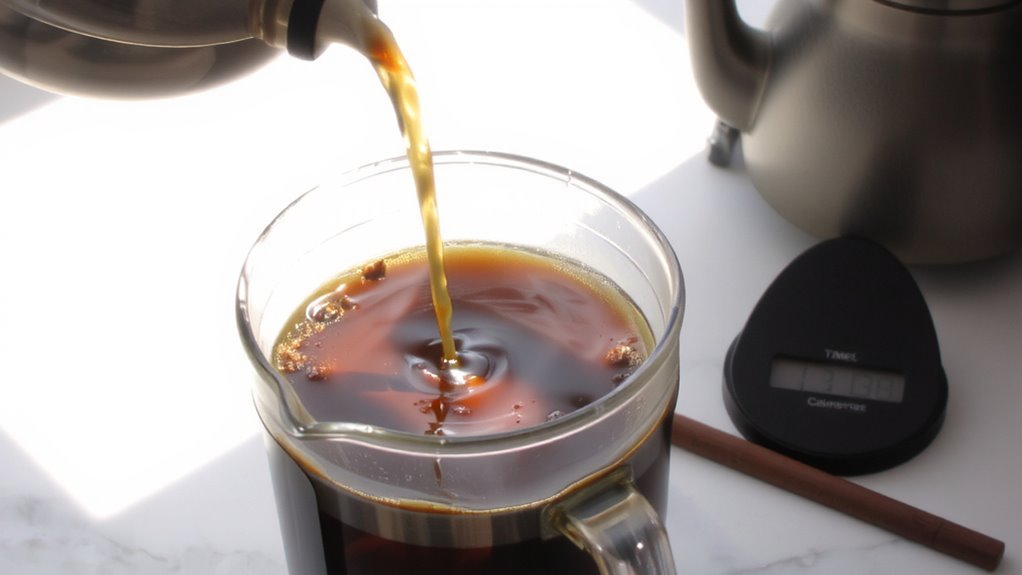
When you’re ready to start, gather your gear: a pour over dripper like the Hario V60 or Kalita Wave, a paper filter, freshly ground coffee, and a gooseneck kettle for precise water control. Use a water temperature between 195°F and 205°F-too hot and it burns the coffee, too cool and it under-extracts. Your grind size should be medium-fine, similar to sea salt; too coarse and the brew is weak, too fine and it over-extracts, turning bitter. Place the filter in the dripper, rinse it with hot water to remove paper taste and preheat the vessel. Add your ground coffee-typically 20 grams for 300 milliliters of water. Start the timer, pour just enough water to saturate the grounds, then pause for 30 seconds. Continue pouring in slow spirals, keeping water levels consistent and avoiding splashing. For consistent, high-quality results, consider using one of the top pour-over coffee makers recommended by experts.
Fix Common Pour Over Mistakes
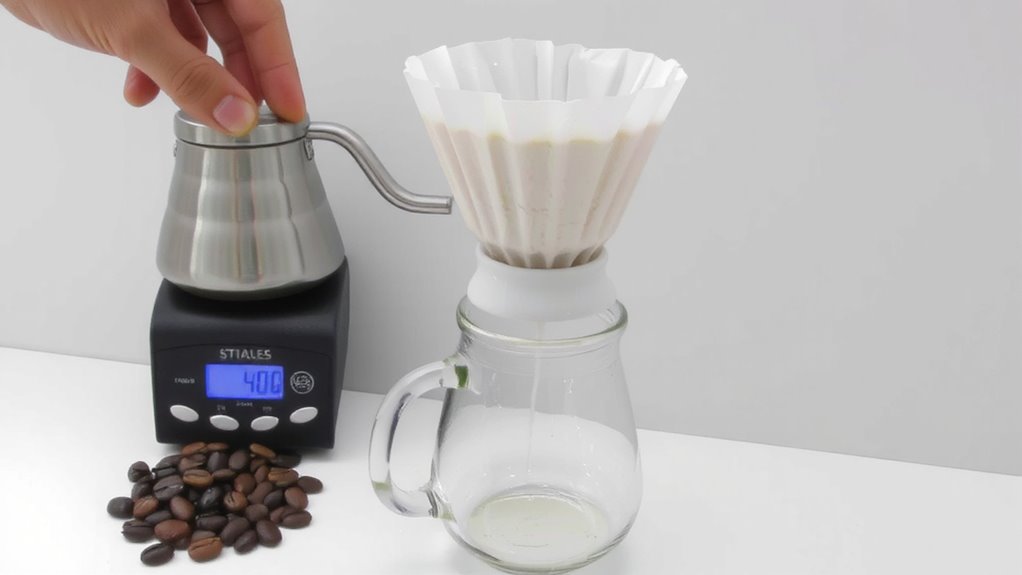
You’ve got the steps down and your gear ready, but even with the right method, small hiccups can throw off your pour over. If your coffee tastes bitter, the water temperature might be too high-aim for 195–205°F. Water that’s too hot burns the grounds, bringing out harsh notes. On the flip side, if the brew tastes weak or sour, your water may be too cool, failing to extract enough flavor. Grind consistency is just as vital. Using uneven grounds leads to unbalanced extraction-some particles over-extract while others under-extract. A burr grinder gives you a uniform size, unlike blade grinders, which create inconsistent bits. If your brew takes too long or chokes, the grind’s likely too fine. If it rushes through, it’s too coarse. Adjusting these two factors-water temperature and grind consistency-fixes most issues and brings your pour over back on track. Maintaining the ideal brewing temperature ensures optimal flavor extraction and a well-balanced cup.
How Brewer Shape Changes Your Coffee’s Taste
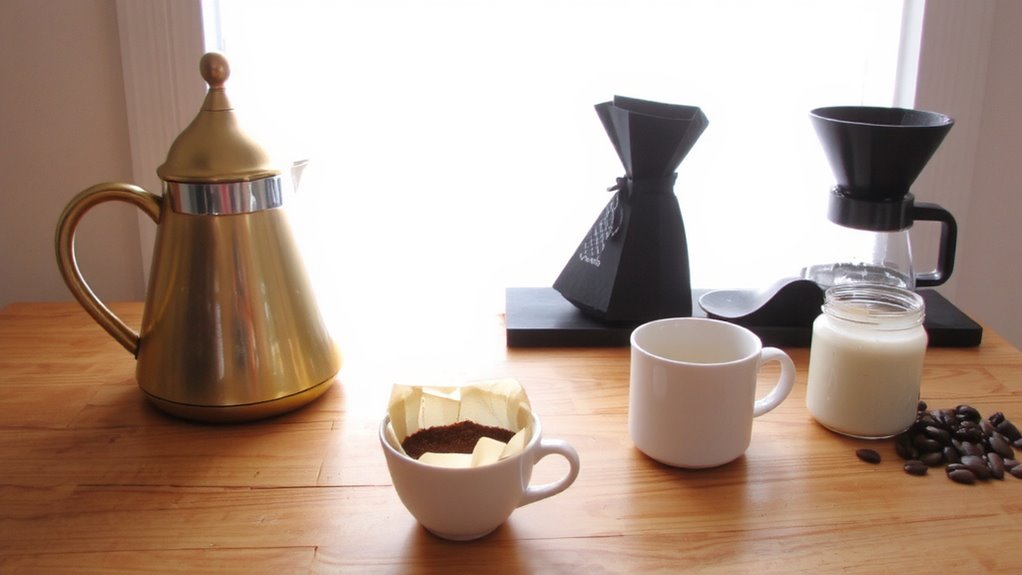
Though you might not think about it at first, the shape of your pour over brewer actually plays a key role in how your coffee tastes. The V60 design uses a steep cone angle that speeds up water flow, giving you a brighter, more vibrant cup with clear flavor separation. In contrast, the Chemex geometry features a flat bottom and shallow angle, which slows extraction and emphasizes body and smoothness. Your grind size and pour technique must match each brewer’s shape to get the best results. Choosing the right pour-over coffee dripper can significantly impact your brewing experience and final cup quality.
Why Pour Over Coffee Tastes Cleaner and Brighter
A single, well-executed pour over often delivers a cup that’s noticeably cleaner and brighter than other brewing methods, and that starts with control. You regulate the water flow, ensuring even extraction without overheating or over-saturating the grounds. This precision highlights subtle flavors others might mask. Water purity plays a key role-impurities in tap water can mute delicate notes, so filtered water helps you taste the coffee as it’s meant to be. Since pour over emphasizes clarity, the bean origin matters more; single-origin beans from regions like Ethiopia or Colombia often showcase floral, citrus, or fruity tones you’d miss in a bolder brew. Because the paper filter removes oils and fine sediments, the result is a crisper mouthfeel. You’re not just making coffee-you’re revealing what’s already in the bean, letting terroir and processing shine through in each sip.
Your Essential Pour Over Brewing Gear
The right gear makes all the difference when brewing pour over coffee, and starting with the essentials guarantees consistency and control. You’ll need a gooseneck kettle-it gives you precision during pouring, letting you manage water flow and saturation evenly. Regular kettles don’t offer that level of control. A pour over cone, like a Hario V60 or Chemex, works best with paper filters, which remove oils and sediment for a clean cup. Cloth or metal filters change the flavor and require more cleaning, so paper filters are simpler and more consistent. Pair your setup with a burr grinder to get uniform coffee grounds-this directly affects extraction. Use a scale to measure coffee and water accurately; consistency hinges on ratios. A timer helps track brew time, so you can replicate results. Together, these tools create a repeatable process. Skip any, and you risk uneven brewing or off-flavors.
On a final note
You’ve got the basics down-use fresh beans, clean water, and the right gear like a Hario V60 or Chemex. Adjust grind size and pour speed to fix weak or bitter coffee. Brewer shape affects flow and flavor, so match it to your taste. Pour over gives clean, bright cups by controlling extraction. Stick to consistent technique, and replace old equipment when needed. It’s simple, repeatable, and worth the attention to detail.