The Science Behind Espresso Pulls: Understanding TDS, Crema Consistency, and Clarity
Your espresso’s taste hinges on Total Dissolved Solids (TDS), crema, and clarity. A refractometer shows TDS-aim for 8–12% to hit 18–22% extraction. Smooth, honey-colored crema means balanced brewing; patchy or dull foam hints at issues. Light roasts boost clarity, revealing origin flavors. Grind size and water temp (92–96°C) directly shape extraction-use a quality grinder like the Baratza Virtuoso. Adjust shot time to 26–29 seconds for ideal flow. Small changes make big differences in your final cup.
Notable Insights
- Total Dissolved Solids (TDS) measure extracted coffee solids, with 8–12% indicating optimal strength and flavor intensity.
- Ideal extraction efficiency (18–22%) balances sweetness and acidity, avoiding sourness from under-extraction or bitterness from over-extraction.
- Crema should be smooth and honey-gold; its texture and color reflect extraction balance and bean freshness.
- Flavor clarity reveals origin characteristics, enhanced by lighter roasts and diminished by dark, scorching roast profiles.
- Consistent grind size and uniform particles prevent channeling, ensuring even extraction and stable shot timing.
What TDS Tells You About Espresso Extraction
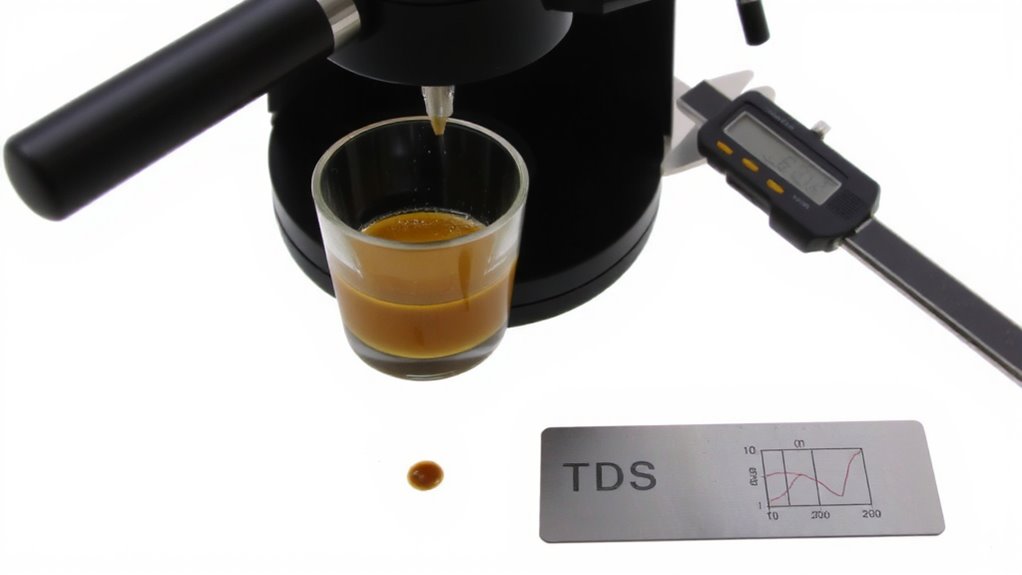
Why does one espresso shot taste sharp while another feels flat, even when pulled from the same machine? It often comes down to Total Dissolved Solids (TDS), which measures the coffee solids extracted into your shot. A higher TDS usually means a stronger, more intense flavor, but only if extraction efficiency is balanced. You’re aiming to dissolve desirable compounds without hitting solubility limits, where water can’t pull more flavor even with longer contact. Under-extracted shots taste sour and weak-efficiency is too low. Over-extracted ones turn bitter, crossing ideal solubility. Tools like refractometers help track TDS precisely, but most baristas rely on taste and yield ratios. A typical target is 18–22% extraction efficiency with 8–12% TDS. Adjust grind size or dose if you’re off. Consistency starts with understanding these numbers, not just timing shots. For accurate TDS measurements, using a calibrated coffee refractometer is essential.
How Crema Reveals Your Shot’s Quality
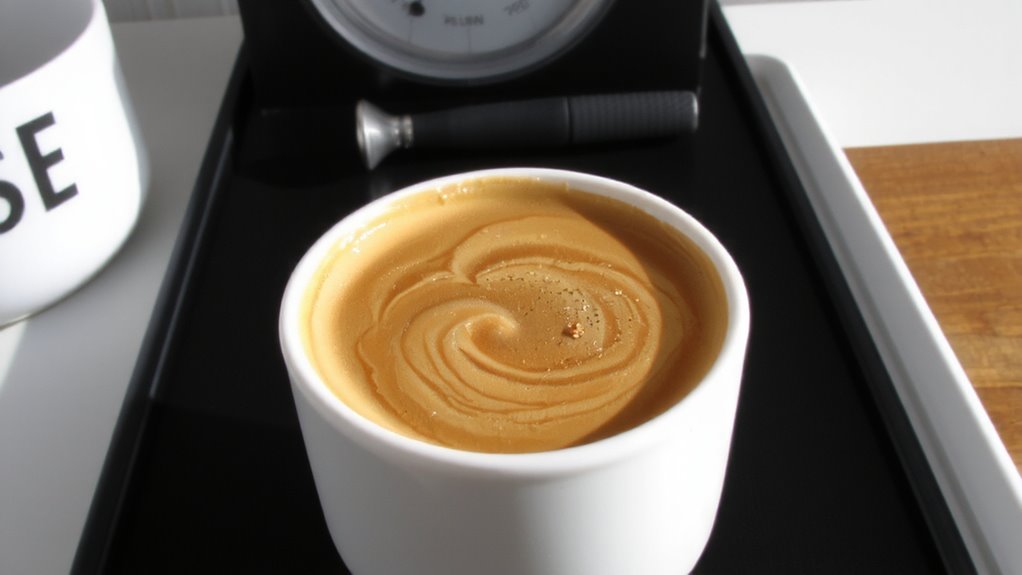
What’s the first thing you notice when a shot pulls? It’s the crema-golden, bubbling, and thick on top. Crema texture tells you a lot: smooth and creamy means balanced extraction, while patchy or thin crema suggests under-extraction or stale beans. If it’s overly thick and dull, your shot might be over-extracted or your grind too fine. Shot color matters just as much-ideal crema ranges from honey-gold to reddish-brown. Dark, almost black crema often points to burnt or overly dark roasted beans. Light, bubbly crema can mean the water wasn’t hot enough or tamping was uneven. You’re aiming for consistency. A tamper like the Pullman Big Step helps, and a distribution tool like the OCD guarantees even grounds. Watch crema texture and shot color together-they’re your quickest visual cues to shot quality without needing lab tools.
Why Clarity Defines Espresso Flavor
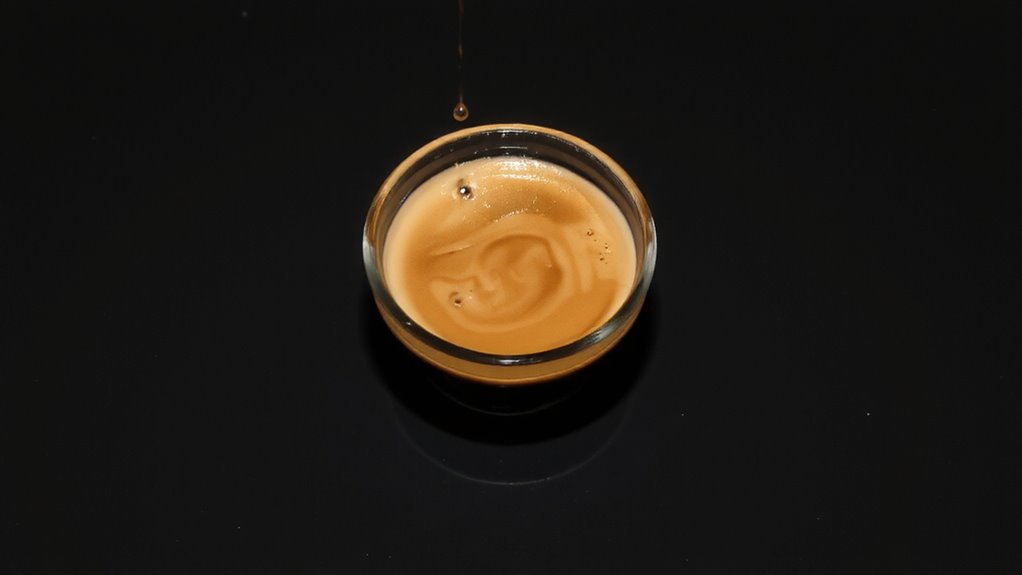
Ever wonder why some espressos taste sharp and clean while others come across as muddled or flat? Clarity is the key. When your shot has clarity, you can distinctly taste notes from the bean origin, like Ethiopian florals or Central American citrus. A lighter roast level often enhances clarity by preserving delicate acids and aromatics, while dark roasts can mask them with char or bitterness. You’re not just chasing strength-you’re chasing definition. If your coffee tastes one-dimensional, it might not be the gear or grind-maybe the roast level dulls the origin character. High-clarity shots reveal complexity without confusion. You’ll notice layered flavors that linger, not clash. It’s not automatic-achieving it means respecting the bean’s story and choosing roast profiles that support, not overpower, its origin. Clarity doesn’t shout. It speaks clearly, if you let it.
How Grind Size Changes Extraction
You can have the right beans and perfect water temperature, but if your grind size is off, the shot won’t reflect the clarity you’re aiming for. Going too coarse means water zips through, under-extracting and leaving sour, weak flavors. Too fine, and the water struggles, over-extracting bitterness. The sweet spot depends on your machine and beans, but consistency matters just as much. Grind uniformity guarantees even extraction-uneven particles lead to some over-extracting while others under-extract. With poor uniformity, you’re more likely to see channel formation, where water carves paths through the loosest parts of the puck, bypassing the rest. That ruins clarity and balance. A good burr grinder, like a Baratza Virtuoso or Mahlkönig EK43, helps maintain tight particle size distribution. Adjusting grind size in small steps and checking shot time lets you fine-tune extraction efficiently. Best burr grinders deliver the precision and consistency essential for achieving optimal extraction in espresso.
How Water Temperature Shapes Your Espresso
Why does one degree make or break your shot? Because water temperature directly controls extraction. Too hot-above 96°C-and you risk scorching the puck, causing bitterness and thermal shock that disrupts even saturation. Too cool-below 90°C-and under-extraction leaves your espresso sour and weak. Most baristas aim for 92–96°C, where solubles extract cleanly without strain. Machines with poor heat retention drift in this range, leading to inconsistent shots, especially during busy periods. PID controllers help, letting you lock temps within 0.5°C, like on the Rocket R58 or Profiteer Boost. Pre-infusion helps stabilize temperature too, reducing thermal shock by gently wetting the grounds. If you’re pulling shots back-to-back, guarantee your boiler recovers fast and group heads stay stable. Your machine isn’t just heating water-it’s managing a delicate balance of heat retention and precision. Get it right, and your espresso tastes balanced, clear, and true.
How Shot Timing Balances Flavor and Strength
What if the difference between a sharp, balanced shot and a muddy, bitter mess comes down to just a few seconds? It does-and shot duration is your best tool for control. Too short-under 25 seconds-and you risk sourness, with under-extracted acids dominating. Too long-past 30 seconds-and bitter, hollow notes creep in from over-extraction. Most specialty cafes aim for 26–29 seconds, targeting ideal flavor balance. Your grinder plays a big role: a finer grind slows flow, increasing extraction; coarser speeds it up, risking weak shots. Machines like the Lelit Anna or Rancilio Silvia let you monitor time consistently. Adjust grind, not dose or pressure, to fine-tune. Watch the stream: a steady, honey-like flow means you’re on track. Master shot duration, and you master strength without sacrificing clarity.
On a final note
You now know how TDS, crema, and clarity guide extraction. Adjust grind size, water temperature, and shot time to fine-tune results. A finer grind slows flow, boosting strength; hotter water can over-extract bitter notes. Use a scale and timer for consistency. Machines like the Breville BES870 or Rocket Appartamento offer temperature control. Clean gear matters-residue skews flavor. Small changes make real differences. Track adjustments, taste objectively, and repeat.