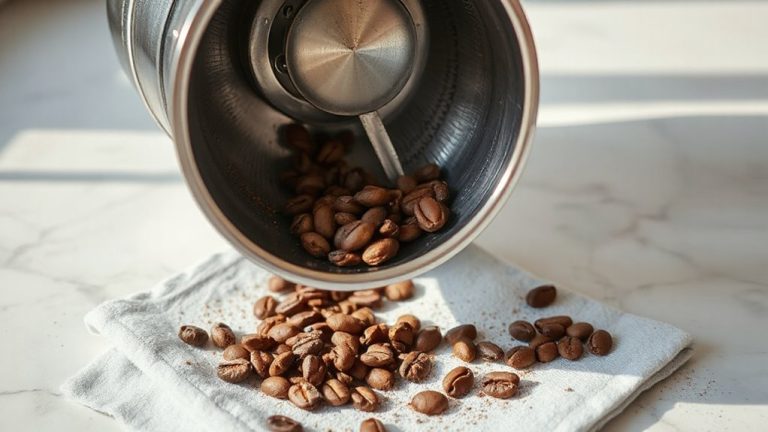
How to Select the Right Burr Type for Your Coffee Grinding Needs
Choose flat burrs if you brew espresso or want precise, consistent grinds-models like the Baratza Virtuoso handle high pressure well. Go for conical burrs if you prefer pour-over or French press; they’re quieter and reduce heat, with less retention, like the Hario Skerton Pro. Flat burrs last longer but need more cleaning. Your brew method and routine decide the best fit-there’s a clear winner once you match it to how you actually use it.
Notable Insights
- Choose flat burrs for espresso and versatile grind size control with consistent particle uniformity.
- Select conical burrs for pour-over or French press to enhance clarity and reduce noise during grinding.
- Prioritize low heat and quiet operation with conical burrs if grinding in shared or small spaces.
- Opt for flat burrs if durability and longer burr life are important for frequent grinding.
- Match burr type to your brew method to improve extraction, flavor balance, and overall coffee quality.
Compare Flat and Conical Burr Mechanics
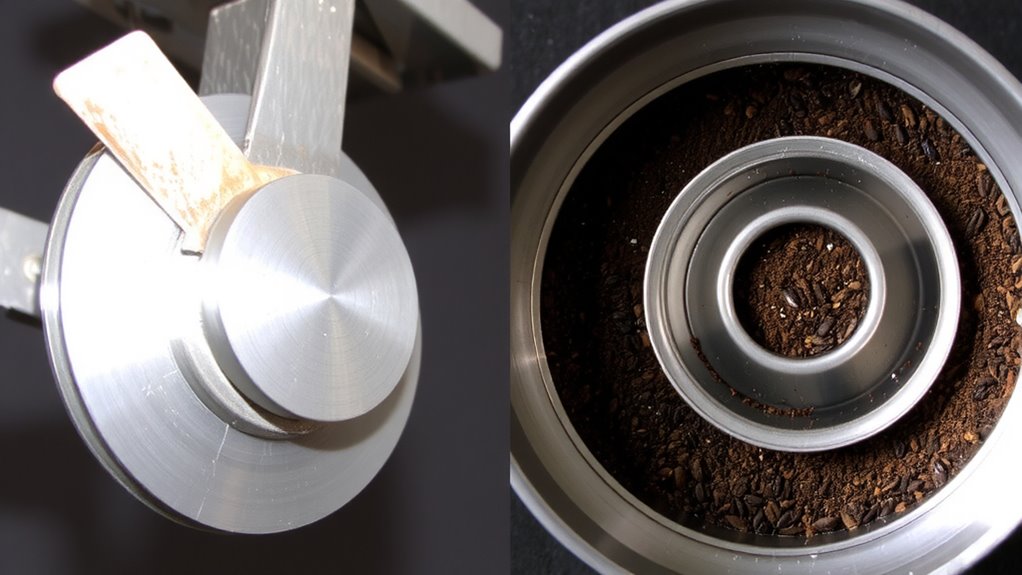
While both flat and conical burrs crush beans between two abrasive surfaces, they do so in different ways that affect grind quality and machine design. Flat burrs are parallel discs that slice beans with even force, producing a uniform particle shape and consistent extraction. They tend to have higher grind retention, trapping more grounds in the chamber, which can stale your coffee if not cleaned often. Conical burrs use a cone-shaped inner burr inside a ring, crushing beans gradually. This design lowers heat and noise while reducing retention, making it easier to keep flavors fresh. Particle shape varies more, but many still find the taste clean and balanced. Machines like the Baratza Virtuoso use flat burrs for precision, while the Hario Skerton Pro uses conical for simplicity. Your choice impacts maintenance needs and flavor clarity, so consider both mechanics when picking a grinder. For more insights, check out recommendations in the best mill grinders guide.
Match Your Brew Method to the Right Burr Type
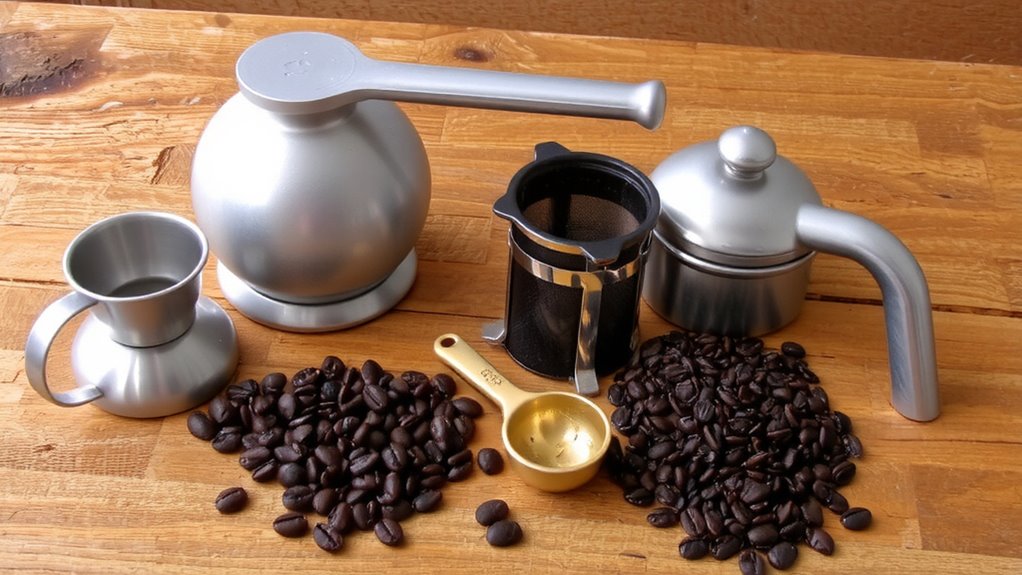
Why does your brew method matter when choosing a burr type? Because different brewing techniques require specific grind sizes and uniformity for ideal brew precision and flavor extraction. If you use a pour-over like a Hario V60, conical burrs are often ideal-they produce a slightly tapered grind that works well with medium to light roasts, enhancing clarity and sweetness. For espresso, flat burrs deliver more consistent particles, essential for the high pressure and short contact time. This consistency improves shot stability and balance. French press users may favor conical burrs too, since they handle coarse grinds smoothly. However, if you switch methods often, flat burrs offer more versatility across grind sizes. Your brewing style directly impacts which burr type supports better results. Match the tool to your method, and you’ll get more from every bean. For a detailed comparison of top-performing models, check out the best coffee grinders guide.
Does Grind Consistency or Heat Affect Flavor More?
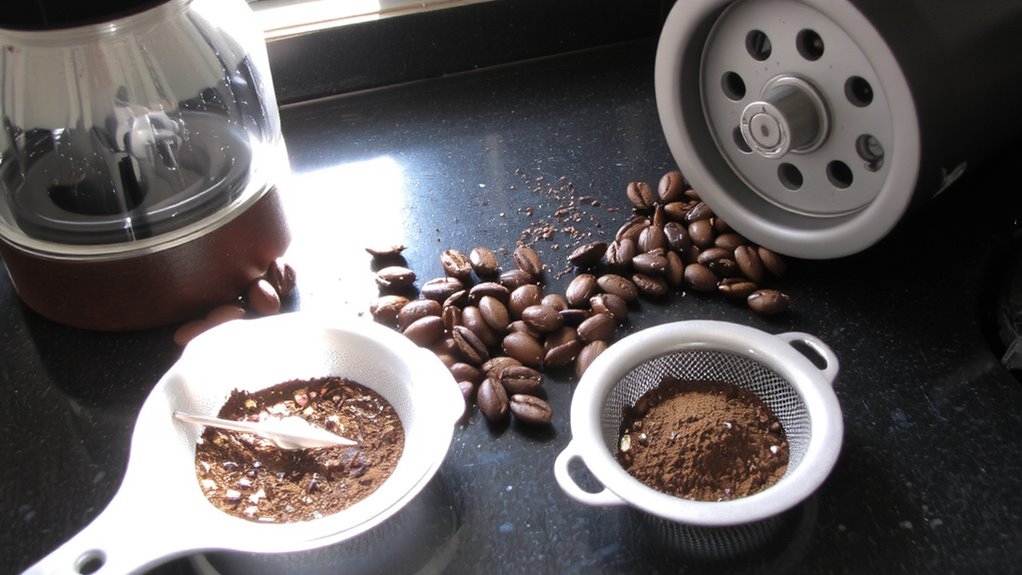
You’ve already picked your brew method and matched it to the right burr type-now it’s time to think about what really shapes your coffee’s flavor: grind consistency and heat. While both matter, grind consistency has a bigger effect on extraction uniformity than thermal impact. Uneven particles extract at different rates, causing sour or bitter notes. A high-quality burr grinder minimizes this with precise mechanics. Heat from fast grinding can subtly alter flavor, but most thermal impact occurs over long sessions, not daily use. For even better results under $500, consider models like the best espresso grinders under $500, which balance consistency and build quality for serious home baristas.
| Factor | Effect on Flavor |
|---|---|
| Grind consistency | Directly affects extraction uniformity; poor consistency leads to unbalanced coffee |
| Heat buildup | Minor thermal impact unless grinding large volumes; rarely changes flavor in home use |
For most brewers, focusing on even particle size delivers better results than worrying about heat.
Quiet vs. Fast: Grinder Speed Trade-offs
How important is a quiet grinder if it means your coffee takes longer to brew? You’ll need to balance noise level and grinding efficiency based on your routine. Low-speed grinders, like those with conical burrs (e.g., Baratza Encore), run quieter-great for early mornings or shared spaces-but may take 20–30 seconds per dose, slightly reducing efficiency. High-speed grinders, often with flat burrs, finish faster but create more noise, sometimes over 80 decibels, similar to a blender. If speed matters-say, in a busy kitchen-a noisier model might save time. But if peace matters more, accept slower grinding. Ultimately, your choice affects your experience more than your brew quality. Pick based on when and where you grind, not just specs. A quieter machine often means a smoother start to your day, even if it’s a bit slower.
Which Burr Type Lasts Longer and Why?
While both conical and flat burr grinders deliver consistent grind sizes, flat burrs generally last longer due to their larger surface area and more even wear over time. Your choice of burr material plays a big role in durability-stainless steel and hardened alloys offer high wear resistance, keeping the edges sharp longer. Since flat burrs spread grinding across more surface, they erode slower than conical ones, especially with daily use.
| Feature | Flat Burrs | Conical Burrs |
|---|---|---|
| Surface Area | Larger, even contact | Smaller, angled contact |
| Wear Pattern | Uniform, slower wear | Concentrated, faster wear |
| Burr Material | Often high-grade steel | Varies, sometimes softer |
With stronger wear resistance and smart design, flat burrs give you more grinding life before needing replacement-ideal if you value long-term performance.
Choose the Best Burr for Your Daily Coffee Routine
What kind of coffee do you make most often-espresso, pour over, or something in between? If you pull espresso daily, you’ll want conical burrs made of hardened steel for their consistent fine grind and low heat retention. Flat burrs also work well but require more precise cleaning. For pour over, both types perform reliably, though flat burrs often offer slightly better uniformity. Your choice affects burr material durability-steel lasts longer than ceramic but ceramic resists heat and corrosion. If you grind multiple times a day, maintenance frequency increases; conical burrs typically need cleaning every 2–3 weeks, while flat burrs may need weekly brushing due to tighter tolerances. Cheaper grinders wear faster, raising long-term costs. For most home users, a mid-range conical grinder like the Baratza Encore balances durability, maintenance ease, and grind quality without overspending.
On a final note
You’ll get the best results by matching your burr type to your brewing method. Conical burrs are quieter, generate less heat, and work well for drip or pour-over. Flat burrs offer more uniform grinds, ideal for espresso, but run hotter and louder. Both last long with proper care, though flat burrs may wear slightly faster. Choose based on your routine: conical for daily filter coffee, flat for precision espresso.