How Colombian Coffee’s National Federation Ensures Quality Standards
You get top-quality Colombian coffee because the FNC sets strict standards every small farmer follows. They test beans for traceability, run lab analyses, and score them on a 100-point scale-only batches over 80 points earn the official seal. Trained cuppers evaluate flavor, acidity, and body to guarantee consistency. The FNC also provides field support and standardized processing guidelines. This system keeps quality high across regions like Huila and Antioquia-if you explore further, you’ll see how it all connects from farm to cup.
Notable Insights
- The FNC enforces strict quality benchmarks requiring a minimum 80-point Specialty Grade for certification.
- Certified coffee undergoes traceability checks from farm to export to ensure authenticity and consistency.
- Regular on-site inspections, sampling, and lab testing monitor bean quality across all stages.
- Trained FNC cuppers conduct sensory evaluations using a standardized 100-point scoring system.
- Farmers receive training and support to maintain quality, including soil testing and proper harvesting techniques.
What Makes Colombian Coffee So High Quality?
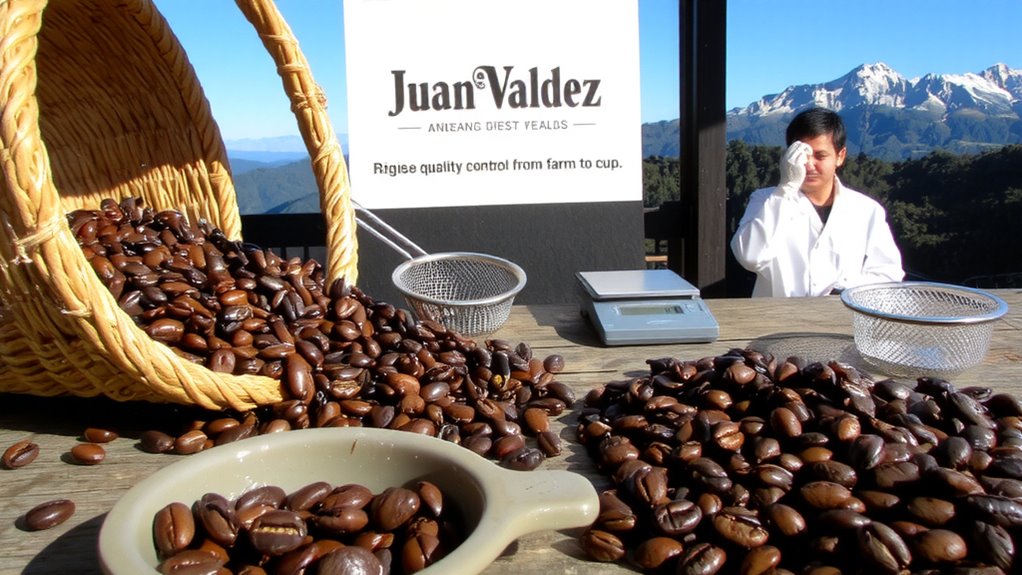
While not every bag labeled “Colombian” guarantees top-tier flavor, a lot of it delivers consistently high quality thanks to tightly controlled growing conditions and strict national standards. You’ll find that Colombian coffee benefits from ideal climate conditions-cool temperatures, consistent rainfall, and high-altitude farms that slow bean development and boost flavor complexity. These factors, combined with carefully selected bean genetics like Castillo and Caturra, help create a balanced, aromatic cup with bright acidity. The FNC supports farmers in maintaining these standards, though this section focuses purely on natural and biological factors. You’re not just buying a region-you’re relying on years of agricultural refinement. When brewing, these beans respond well to medium roasts and pour-over methods. If you’re comparing origins, think of Colombian beans as a reliable baseline, especially when sourced from Antioquia or Huila.
What the FNC Is and Why It Matters
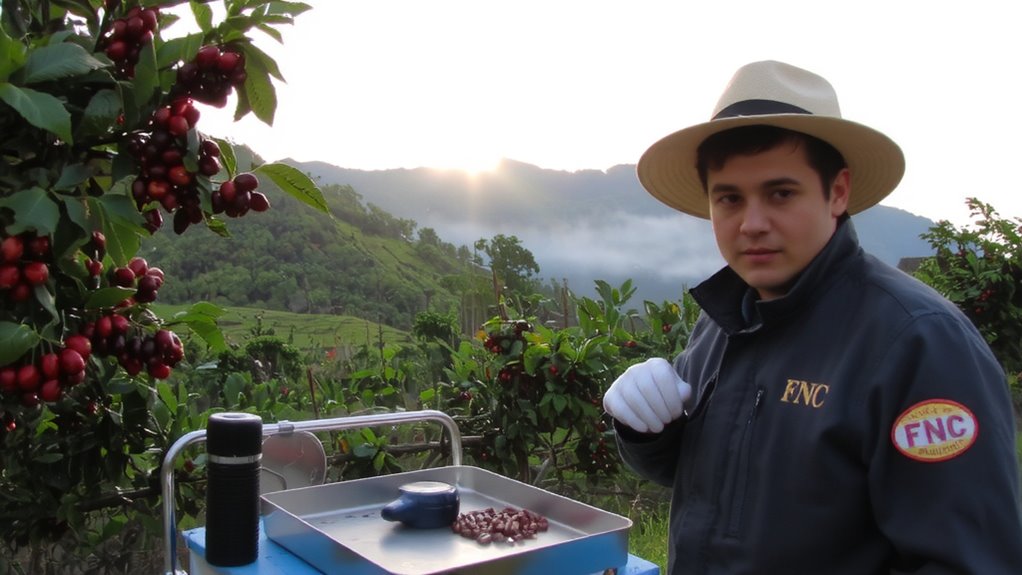
You’ve probably heard the name FNC linked to Colombian coffee, especially if you’ve seen that familiar Juan Valdez logo on a bag. The Federación Nacional de Cafeteros (FNC) is a nonprofit group formed in 1927 to support small coffee farmers. It plays a big role in Colombia’s coffee history and helps shape the country’s national identity. By uniting over 500,000 farming families, the FNC gives them stronger market access and fairer prices. It also funds research, infrastructure, and education to improve farming practices. Unlike coffee from countries with government-run systems, Colombia’s cooperative model lets farmers retain ownership while still benefiting from large-scale support. This balance helps maintain both quality and sustainability. The FNC’s work doesn’t just affect taste-it guarantees stability in supply and fairness in trade, making it a key reason Colombian beans remain consistent and trusted worldwide.
How the FNC Enforces Coffee Quality Standards
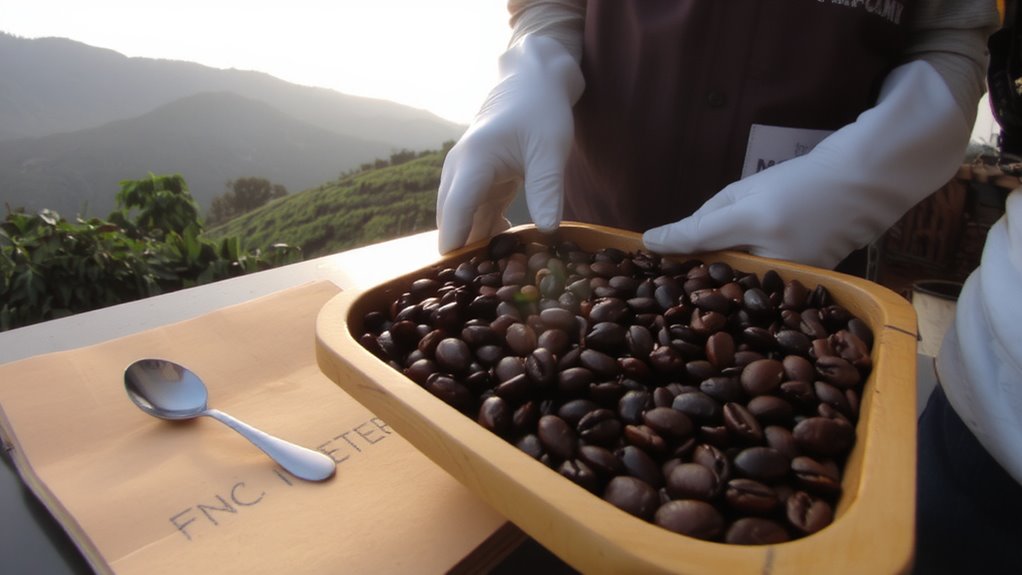
Every bag of certified Colombian coffee meets strict quality benchmarks set by the FNC, and they don’t leave it to chance. You can trace each batch through a rigorous certification process that starts at the farm and ends at export. The FNC runs regular inspections and collects samples to guarantee consistency in flavor, aroma, moisture content, and bean size. Their quality control system includes lab testing and sensory evaluations by trained tasters, called cuppers, who score each lot. If coffee fails to meet the minimum 80-point Specialty Grade, it doesn’t get certified. Only beans that pass every stage earn the official seal. This process protects the reputation of Colombian coffee globally. While it adds cost, it guarantees you’re getting authentic, high-grade coffee. Other countries lack this level of oversight, making Colombia’s approach a gold standard in traceability and quality control.
FNC Training for Small Coffee Farmers
Because small coffee farmers form the backbone of Colombia’s coffee industry, the FNC invests heavily in training programs that improve both crop quality and sustainability. You receive hands-on instruction in key practices like soil testing, which helps determine nutrient levels and pH balance, letting you apply the right fertilizers efficiently. The FNC also teaches crop rotation techniques to prevent soil depletion and reduce pest buildup, which protects your yield over time. These methods aren’t optional extras-they’re part of a proven system used by thousands of farmers across the Andes. Training is practical: you learn how to collect soil samples correctly and interpret results using local lab services. When you rotate coffee with shade or legume crops, you improve long-term farm health. The FNC provides field guides and mobile advisors so you can apply these strategies year after year, ensuring consistency and quality from harvest to export.
FNC Programs for Sustainable Coffee Farming
While boosting coffee quality starts on the farm, the FNC’s sustainability programs make sure those gains last. You’re supported through initiatives promoting organic farming, which reduces chemical use and improves soil health over time. The FNC provides guidance on natural pest control and composting, helping you maintain yield without synthetic inputs. Water conservation is also key-farmers like you adopt eco-pulpers that cut water use by up to 90% compared to traditional methods. You’re encouraged to reuse water in processing and collect rainwater during wet seasons. These practices lower environmental impact and operating costs. While switching takes effort and time, the FNC offers technical aid and incentives to help you shift. You’ll see results in bean consistency and farm resilience. Sustainable methods aren’t just good for the planet-they make your operation more efficient and future-proof.
How FNC Research Improves Colombian Coffee
You can trace much of Colombia’s high coffee quality back to the FNC’s ongoing research, which targets real-world farming challenges with science-based solutions. Through genetic innovation, the FNC develops disease-resistant coffee varieties like Castillo and Cenicafé 1, reducing crop loss and cutting pesticide use. These advances support climate resilience by creating plants that withstand temperature shifts, erratic rainfall, and pests worsened by warming conditions. Farmers gain reliable, high-yield options without sacrificing bean quality.
| Research Focus | Practical Benefit |
|---|---|
| Genetic innovation | Fewer crop losses, less chemical use |
| Climate resilience | Stable harvests in changing weather |
| Pest resistance | Lower costs, less labor |
| Water efficiency | Better yields in dry seasons |
| Soil health | Longer farm productivity |
These tools help you source more consistent, sustainable beans, especially as global conditions shift.
How the FNC Secures Fair Prices for Colombian Coffee
A significant part of ensuring fair prices for Colombian coffee falls to the FNC, which uses a mix of market intervention and direct support to stabilize what you pay as a buyer and what farmers earn. The FNC steps in when global prices drop, buying coffee directly to prevent collapse-this price stabilization protects small producers from volatile markets. You benefit too, since steadier costs mean more predictable sourcing. While not all Colombian coffee is Fair trade certified, the FNC’s model delivers similar outcomes by guaranteeing minimum payments and covering transport. This system avoids reliance on third-party labels while maintaining fairness. Unlike co-ops in other regions that depend on Fair trade premiums, Colombia’s setup offers efficiency and scale. The result? You get consistent quality, farmers get reliable income, and the supply chain stays resilient. It’s practical, proven, and built to last-no certification stamps needed.
On a final note
You get consistent, high-quality Colombian coffee because the FNC sets strict standards, trains farmers, and promotes sustainable practices. Their oversight guarantees beans are grown, processed, and graded uniformly. If you’re brewing at home, look for the “100% Colombian” seal-it’s backed by real quality control. The FNC’s role means you’re more likely to enjoy a clean, flavorful cup every time. Know your source-it matters.