Dialing in Medium Grind for Pourover Competitions With Gooseneck Kettles
You need a consistent medium grind for pourover competitions with a gooseneck kettle-use a burr grinder like the Baratza Encore or Fellow Ode for even particles. Aim for a 2:30–3:30 brew time with 15g coffee, adjusting finer if too fast or coarser if too slow. Fresh beans (8–21 days out) work best at standard settings; older or denser beans need tweaks. Pair with 195–203°F water and a narrow-spout kettle for control. The right setup reveals how small changes shape extraction.
Notable Insights
- Use a high-quality burr grinder like Baratza Encore or Fellow Ode for consistent medium grind size.
- Aim for a 2:30 to 3:30 minute brew time with a 15g dose to optimize extraction.
- Adjust grind finer for stale beans (22+ days post-roast) and coarser for fresher beans (3–7 days).
- Maintain water temperature between 195–203°F to avoid under- or over-extraction.
- Pair a gooseneck kettle with a 3–4 mm spout for precise, controlled pouring and even saturation.
The Precision Grind Needs of Gooseneck Kettles
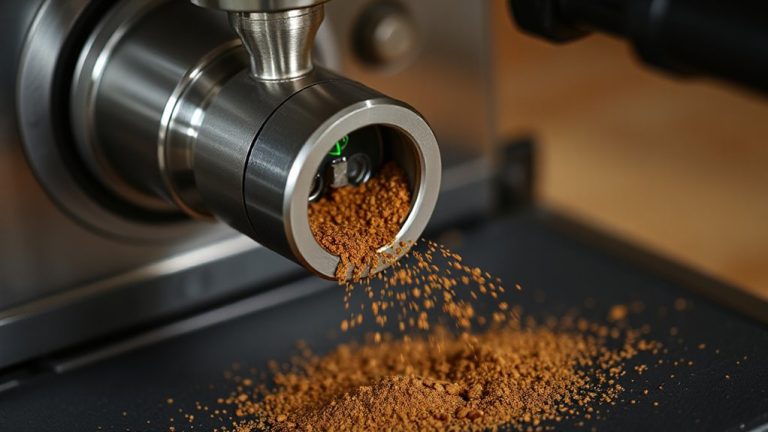
While you might think your gooseneck kettle does all the work during a pour-over, the truth is your grinder plays just as big a role-especially since gooseneck kettles are designed for slow, controlled water flow that demands an exceptionally consistent medium grind. Without grind consistency, even the most precise pouring technique falters; uneven particles extract unevenly, leading to sour or bitter notes. You need a burr grinder-like a Baratza Encore or Fellow Ode-for uniform particle size. This guarantees flow control stays predictable, preventing channeling where water speeds through gaps in coarse or fine clumps. With poor grind consistency, your gooseneck’s precision is wasted. A stable grind sets the stage for even saturation and steady flow, directly affecting flavor clarity and balance. It’s not just about grind size-it’s about uniformity. Your kettle controls water placement, but your grinder controls extraction potential. Prioritize consistency to get the most from your setup. For competitive pour-over, consider a dual-purpose grinder like the best grinder for espresso and pour-over.
Step-by-Step: Dialing In Your Medium Grind
How do you know when your grind’s actually dialed in? You’ll see a steady flow rate-neither too fast nor too slow-during your pour. Start by grinding a small batch and checking for grind consistency; if particles vary widely, your extraction will be uneven. Use a burr grinder like a Baratza Virtuoso or Timemore C2, which offer finer control. Adjust the setting slightly finer if the brew runs too quickly, or coarser if it stalls. Test each change with a timed pour: aim for a 2:30 to 3:30 minute total brew time for a 15g dose. Watch how water moves through the bed-consistent drops off the filter signal balanced flow. Repeat tasting and tweaking until flavors are clean and balanced. Don’t rush it. Small adjustments make big differences in the cup. A consistent medium grind size is crucial, and investing in one of the best coffee grinders for pour-over can significantly improve your brewing precision.
How Bean Freshness and Roast Affect Grind Size
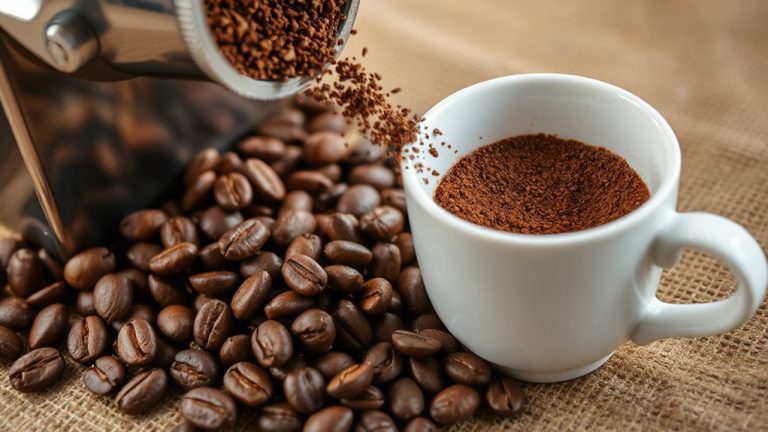
Since freshly roasted beans release CO₂, your grind size needs to adapt depending on how long it’s been since roasting. As bean age increases, gases escape, slowing extraction-so you’ll need a finer grind over time to compensate. Roast density also plays a role: denser beans, like high-altitude Africans, resist grinding and extract slower, often needing a slightly coarser setting. A high-quality burr grinder ensures consistent particle size, which is critical for achieving balanced extraction in pourover competitions.
| Bean Age | Suggested Grind Adjustment |
|---|---|
| 3–7 days | Slightly coarser |
| 8–21 days | Medium (standard) |
| 22+ days | Finer |
Lighter roasts usually have higher roast density, requiring more grind adjustment than darker, more brittle roasts. Don’t treat density and bean age as separate issues-they interact. A dense, young bean needs a different approach than a less dense, older one. Adjust incrementally, and always taste as you go. Your gooseneck helps, but correct grind choice makes the real difference.
How Water Temperature Shapes Medium Grind Extraction
What if the water temperature you’re using is actually masking the true potential of your medium grind? If your water’s too hot-above 205°F-you risk scalding the coffee, bringing out bitter notes even with a balanced medium grind. Too cool-below 195°F-and you under-extract, leaving the cup sour and thin. The sweet spot? 195–203°F, where extraction is even and flavors pop clearly. But temperature alone isn’t the whole story. It interacts with water chemistry. Soft water lacks the mineral balance to carry flavor, while overly hard water exaggerates bitterness. Aim for balanced, filtered water with moderate minerals-like Third Wave Water or a custom mix-to support clean, nuanced extraction. That clarity lets your medium grind shine, revealing the roast’s true character without distortion. Adjust temperature first, but always consider your water chemistry to fine-tune results.
How Kettle Design Influences Your Ideal Grind
Ever wonder why your medium grind behaves differently depending on the kettle you use? The truth is, your gooseneck kettle’s design directly impacts extraction. Kettle material-like copper, stainless steel, or titanium-affects heat retention and responsiveness. Copper holds heat well, helping maintain stable water temperature, while stainless steel is lighter and more durable but cools faster. More importantly, the spout’s shape dictates pour symmetry. A narrow, elongated gooseneck gives you precision and even dispersion, essential for blooming and controlled pours. Poorly designed kettles create uneven streams, leading to channeling and inconsistent extraction in your medium grind. You’ll struggle to replicate results, even with the same technique. For competition-level consistency, choose a kettle with balanced weight, a 3–4 mm spout, and excellent pour symmetry. It’s not just about style-it’s about control.
On a final note
You’ve got better control with a gooseneck kettle, so dialing in a medium grind comes down to consistency and adjustments. Match grind size to fresh beans and roast level-lighter roasts often need finer settings. Use water just off boil, around 200°F. Test small changes, noting how flow rate and kettle design affect extraction. A Kalita Wave or Hario V60 each need slightly different prep. Track results to repeat what works.