Achieve Balanced Drip Coffee Brewing Through Precise Grind and Dosage Control
Use a medium grind, like table salt, and a 1:15 to 1:17 coffee-to-water ratio for balanced drip coffee. A burr grinder like the Baratza Encore guarantees even particles, while a digital scale (e.g., Acaia Pearl) beats scoops for accuracy. Keep water between 195°F and 205°F, with brew time at 4–6 minutes. Adjust grind or ratio if coffee tastes sour or bitter. You’ll find how small tweaks lead to big improvements with the right tools and method.
Notable Insights
- Use a medium grind size, similar to table salt, to ensure balanced extraction and avoid bitterness or sourness.
- Employ a 1:15 to 1:17 coffee-to-water ratio for optimal strength and flavor clarity in drip brewing.
- Grind coffee with a burr grinder for uniform particles, preventing under- or over-extraction from inconsistent sizes.
- Measure coffee and water with a 0.1-gram precision digital scale to ensure consistent, repeatable brews.
- Maintain water temperature between 195°F and 205°F to achieve proper extraction within a 4–6 minute brew time.
The Right Grind Size for Drip Coffee
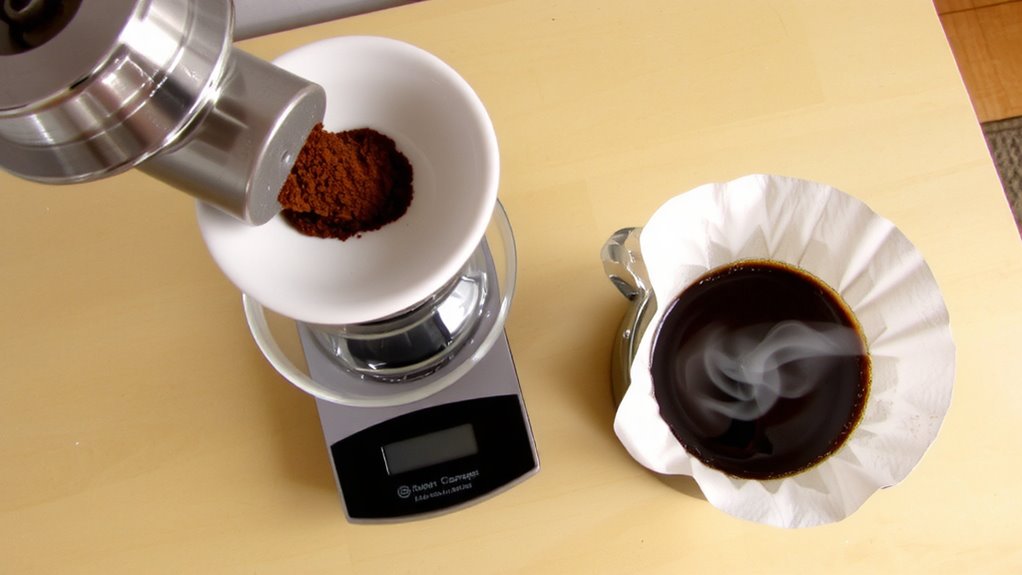
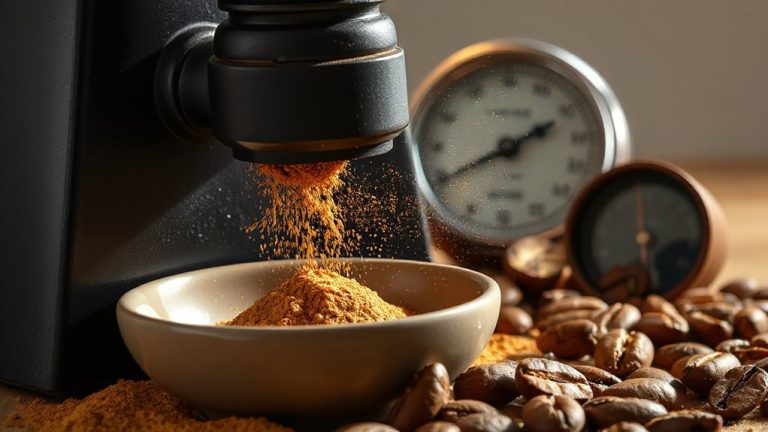
Grind size can make or break your drip coffee. Too fine, and you’ll get over-extraction-bitter, harsh tastes. Too coarse, and it’s weak and sour. For drip brewing, aim for a medium grind, similar to table salt. This size works best with most auto-drip machines, allowing balanced extraction with standard brew times. But it’s not just about size-grind consistency matters just as much. Uneven particle distribution leads to uneven extraction: some bits over-extract while others under-extract. That’s why blade grinders often disappoint-sporadic particle distribution ruins clarity. A burr grinder delivers better grind consistency, producing uniform particles. Models like the Baratza Encore or Fellow Ode keep extraction even and flavors clean. If your coffee tastes off, check your grinder first. Consistent particle size isn’t a luxury-it’s essential for balanced drip coffee. For optimal results with freshly roasted beans, consider a grinder from the list of best coffee grinders for freshly roasted beans.
The Best Coffee-to-Water Ratio for Balanced Drip Coffee
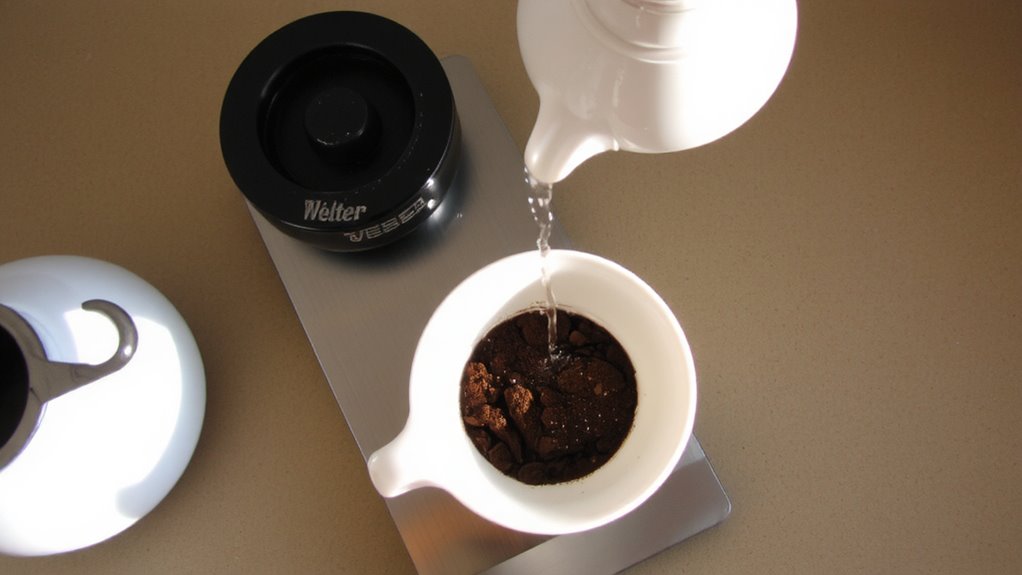
A good starting point for balanced drip coffee is a 1:15 to 1:17 coffee-to-water ratio-about 1 gram of coffee for every 15 to 17 grams of water. This range works well for most drip machines and roast levels. You’ll get a clean, balanced cup without over-extraction or weak flavor. Keep your water temperature between 195°F and 205°F; too low and the extraction suffers, too high and bitterness creeps in. Brew time should be around 4 to 6 minutes-if it’s faster, your coffee might taste thin; slower, and it risks being bitter. Adjusting the ratio slightly up or down lets you fine-tune strength and flavor. A 1:15 ratio makes a stronger cup, while 1:17 gives a lighter body. These variables work together, so small tweaks make noticeable differences. Consistent ratios, proper water temperature, and correct brew time set the foundation for quality drip coffee every time. For accurate measurements, consider using a digital scale and coffee ratio tools to maintain consistency in every brew.
Weigh It: Scales Beat Scoops Every Time
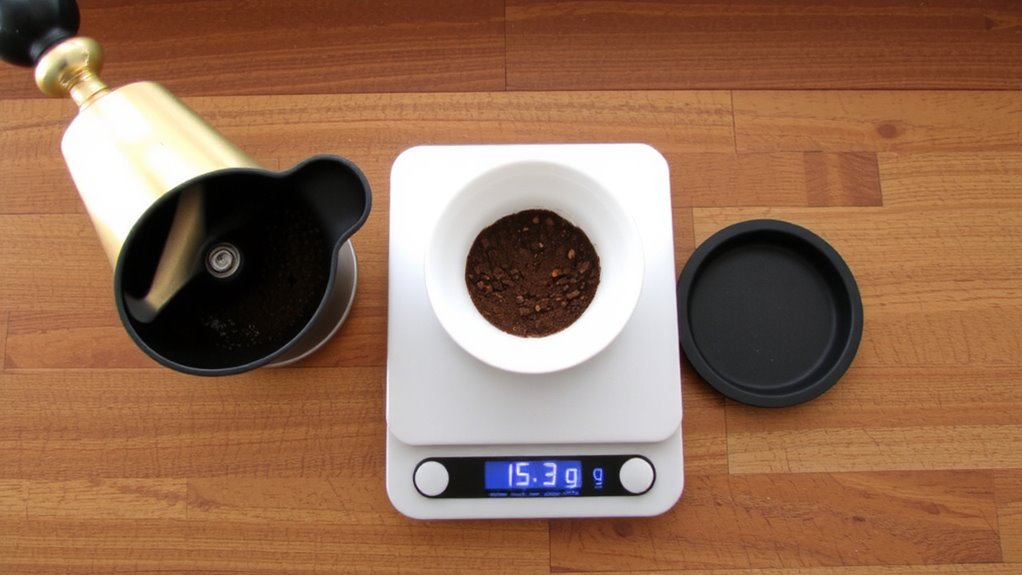
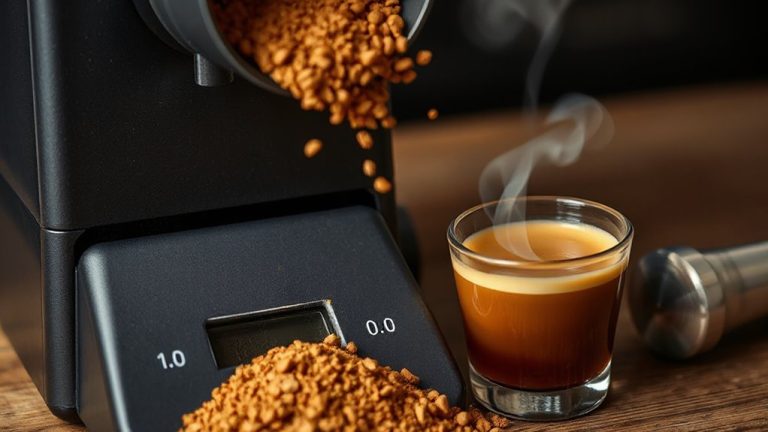
Most baristas and coffee lovers who want consistent results use a scale instead of a scoop-because even a small difference in coffee weight can change how your brew tastes. You’re after brewing consistency, and volume measurements just can’t deliver that. A scoop varies with grind size: finer grounds pack more into the same space, throwing off your ratio. But a digital scale-like the Hario V60 Drip Coffee Scale or Acaia Pearl-measures mass, not volume, so every gram is exact. That precision protects coffee freshness too, since you’re not over- or under-extracting due to inconsistent dosing. Over time, scoops lead to wasted beans and uneven batches. Scales cost $20–$100, but they pay off fast in better, repeatable results. You’ll notice fewer flat or sharp notes, just balanced, stable flavor. If you want your coffee to taste the same every morning-and get the most from your beans-a scale isn’t optional. It’s essential. For those looking to upgrade, our top picks offer reliable options tailored to different brewing styles and budgets.
Fix Sour, Bitter, or Weak Coffee Fast
If your coffee tastes sour, chances are you’re under-extracting, which means the water pulled too little from the grounds-often because the grind is too coarse or the brew time’s too short. Bitter flavors? That’s over-extraction, usually from too fine a grind or excessive brewing time. Weak coffee often points to low coffee-to-water ratio or low water temperature. Adjusting water temperature between 195°F and 205°F and tweaking brewing time can fix most issues fast.
| Issue | Likely Fix |
|---|---|
| Sour | Finer grind, longer brew time |
| Bitter | Coarser grind, shorter brew |
| Weak | Increase dosage or temperature |
| Flat | Check water temp and time |
Match adjustments to taste, and track changes for consistency.
Use These Clues to Nail the Perfect Grind Size
How do you know when your grind size is actually right? You’ll taste it-balanced coffee means no overwhelming sourness or bitterness. If it’s sour, your grind’s likely too coarse; if it’s bitter, probably too fine. The key lies in grind uniformity and proper particle distribution. Uneven particles cause uneven extraction-some over-extract, others under-extract. Blade grinders, for example, create erratic particle distribution, making consistency a challenge. A good burr grinder improves grind uniformity, leading to more even extraction. For drip brewing, aim for a medium-fine grind, similar to table salt. Too many fines? Coffee turns muddy. Too many boulders? It’ll taste weak. Adjust in small increments. Watch how long the brew takes-2 to 4 minutes is ideal. Tweak the grind until flavor and time align. That’s how you nail it.
Pick the Right Grinder and Scale for Better Drip Coffee
You’ve seen how grind size shapes extraction and flavor, so it’s time to talk tools that actually let you control it. A good burr grinder is non-negotiable-blenders or blade grinders won’t give consistent particle size. Look for one with easy grinder calibration, like the Baratza Encore or DF64, so you can fine-tune settings between batches. Stepped grinders are reliable; stepless offer more precision. Pair it with a digital scale that has 0.1-gram resolution for proper scale accuracy. Models like the Hario V60 Dripper Scale or Acaia Pearl update fast and stay accurate over time. Skip kitchen scales-they’re too slow and imprecise. With consistent grinder calibration and reliable scale accuracy, you’ll replicate results and fix brewing issues fast. It’s not about luxury-it’s about control. You don’t need the most expensive gear, just tools that measure and grind the same way every time. That’s how you get balanced drip coffee.
A 5-Minute Routine for Perfect Drip Coffee Every Time
While consistency matters more than speed, dialing in a repeatable five-minute routine helps you brew balanced drip coffee without overcomplicating things. Start by heating your water to 200°F while you measure 30 grams of whole beans. Grind them medium-coarse, like sea salt, using a burr grinder for brewing consistency. Place a filter in your dripper-like a Hario V60 or Chemex-and rinse it with hot water. Add the grounds, shake gently to level, then begin pouring. Start with a 60-gram bloom for 30 seconds. Then, pour in slow spirals to reach 500 grams total by 3:30. Let it drip through by 4:30. Remove the dripper, swirl your carafe, and serve. Doing this each time turns coffee into a reliable morning ritual. It’s simple, repeatable, and yields clean, balanced flavor day after day.
On a final note
You’ve got the tools and steps to brew better drip coffee. Use a burr grinder like the Baratza Encore for consistent size, weigh beans with a scale like the Hario V60 Drip Scale, and stick to a 1:16 coffee-to-water ratio. Adjust grind finer if coffee tastes sour, coarser if bitter. A quick 5-minute routine-measure, grind, pour, brew-keeps results reliable. Skip scoops; always weigh. It’s not magic, just method.