Optimizing Drip Coffee Machines for Enhanced Taste Profiles
Use freshly roasted beans and grind them just before brewing with a conical burr grinder for consistent results. Aim for a medium grind, like table salt, and stick to a 1:16 to 1:18 coffee-to-water ratio by weight. Filter your water to remove chlorine and balance minerals-try a Brita or PUR filter. Clean your machine weekly and descale monthly, or more often with hard water. Brew between 195°F and 205°F, and let the grounds bloom for 30 seconds. You’ll find small tweaks make a real difference. There’s a bit more to fine-tune for your ideal cup.
Notable Insights
- Use freshly roasted whole beans and store them in an opaque, airtight container at room temperature to preserve flavor.
- Grind coffee with a conical burr grinder to achieve a consistent medium grind size, similar to table salt.
- Follow a precise coffee-to-water ratio between 1:16 and 1:18 by weight for balanced extraction and optimal strength.
- Use filtered water to eliminate chlorine and maintain balanced minerals necessary for proper flavor extraction.
- Clean and descale the drip machine regularly with vinegar or a dedicated solution to ensure ideal brew temperature and performance.
Why Your Drip Coffee Tastes Bland
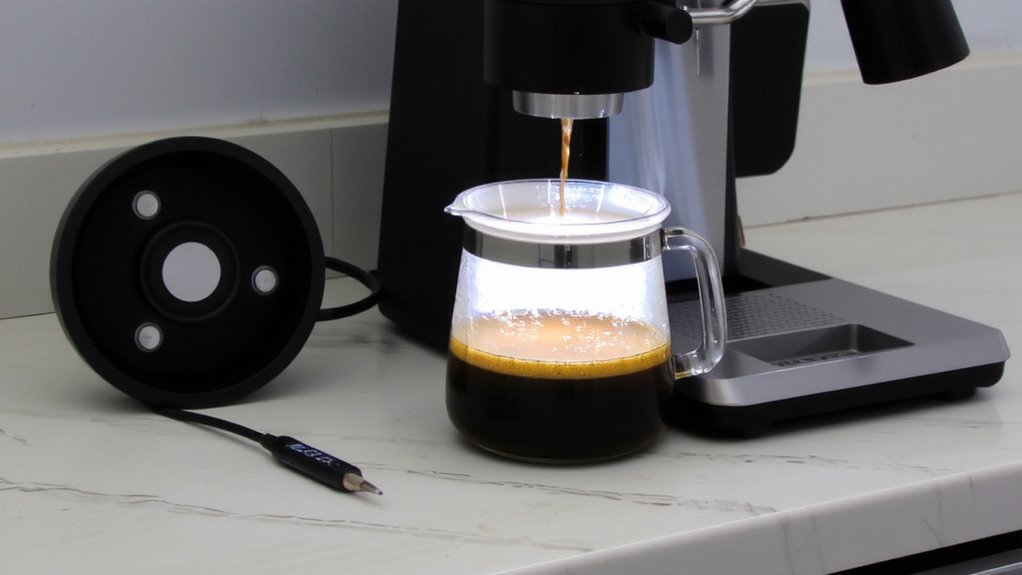
Why does your drip coffee taste flat or weak? The issue often starts before brewing. Old coffee beans lose their essential oils and aromatic compounds over time, producing a dull, lifeless cup. If beans sit for weeks after roasting, even in a sealed bag, they degrade in quality. Once opened, overexposure to air accelerates staling-oxygen breaks down flavor rapidly. Ground coffee worsens this: greater surface area means faster oxidation. For best results, buy whole beans in small batches and check roast dates. Use them within 2–3 weeks of opening. Store in an opaque, airtight container at room temperature, not in the fridge or freezer-moisture and temperature swings harm flavor. A properly designed coffee bean storage solution can significantly extend freshness by minimizing exposure to light, air, and moisture. If your machine delivers weak coffee despite correct settings, don’t adjust the brewer yet. First, verify your beans’ freshness. New, properly stored beans often fix blandness without any gear changes.
Use the Best Grind Size for Drip Coffee
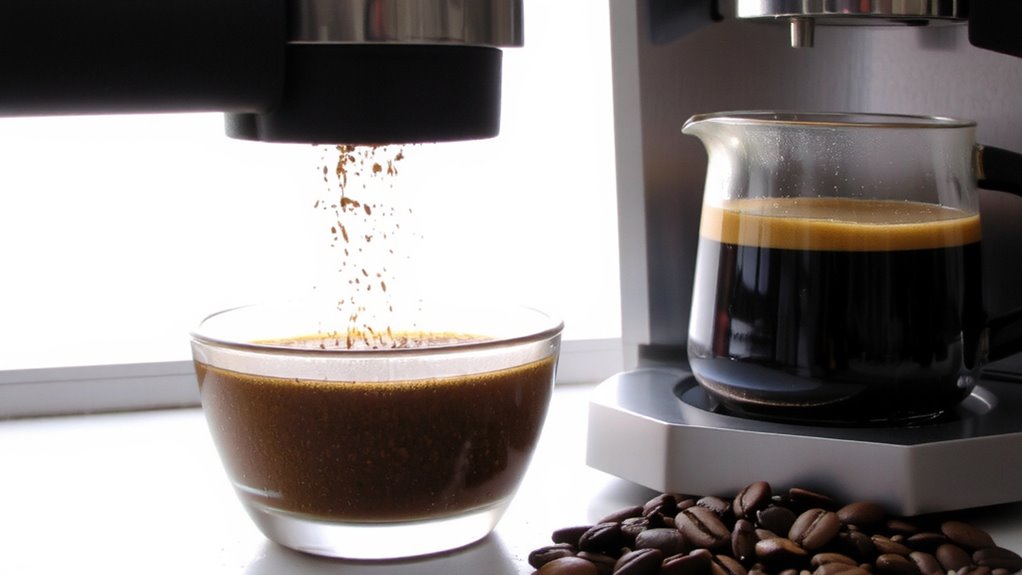
The grind size you use makes or breaks your drip coffee’s flavor. Too fine, and your brew turns bitter; too coarse, and it’s weak and under-extracted. For most drip machines, a medium grind-similar to table salt-works best. This balances extraction time and surface area, pulling the right flavors from your beans. But it’s not just about size: grind consistency and particle distribution matter just as much. A burr grinder gives you uniform particles, improving extraction. Blade grinders? They create uneven particle distribution, leading to mixed results-some over-extracted, some under. Inconsistent grind means flat or off-balance coffee. If you’re serious, invest in a decent conical burr model like the Baratza Encore. It’s affordable and delivers reliable grind consistency. Your machine can only do so much-start with good, even grounds, and you’ll taste the difference. The best coffee grinders according to Wirecutter consistently highlight models that deliver precision and durability for optimal brewing results.
Get the Perfect Coffee-to-Water Ratio
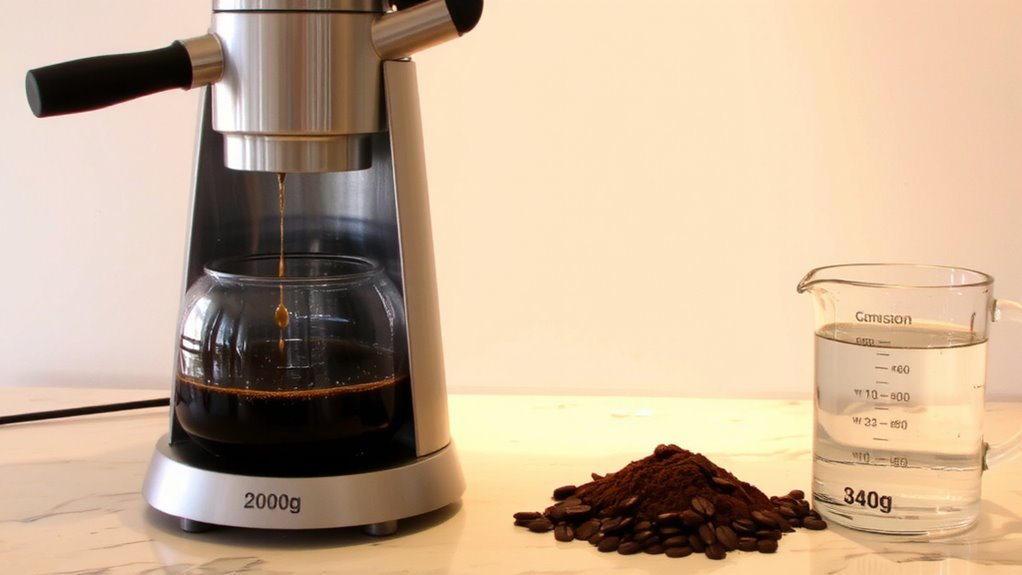
A good starting point for most drip coffee is about 1 to 2 tablespoons of ground coffee per 6 ounces of water, but the exact ratio depends on your taste and bean freshness. If your beans are freshly roasted-ideally within two to three weeks-you’ll get stronger flavor, so you might use slightly less coffee. Older beans lose aroma and complexity, often needing a bit more to taste right. The bean origin also matters: beans from Ethiopia may brew lighter and floral, requiring a denser ratio, while Sumatran beans tend to be bold and earthy, possibly needing less. Start with 2 tablespoons per 6 ounces, then adjust in small increments. Use a kitchen scale for accuracy-aim for a 1:16 to 1:18 coffee-to-water ratio by weight. Tweaking this balance improves clarity and body, giving you consistent, better-tasting coffee every time. For precise measurements, consider using one of the best coffee ratio tools designed to simplify achieving your ideal coffee-to-water ratio.
Brew With Filtered Water for Better Taste
You’ll get noticeably better coffee by using filtered water instead of tap, since what you brew with directly affects flavor. Tap water often contains chlorine and inconsistent mineral content, both of which can distort taste. Chlorine removal is essential-its sharp odor clashes with delicate coffee notes, dulling the experience. Meanwhile, balanced mineral content helps extract flavors properly during brewing; too little and coffee tastes flat, too much and it becomes bitter or scaled. A simple carbon filter, like those in Brita or PUR pitchers, improves taste by reducing chlorine and moderating minerals. For even better control, some use third-wave water blends designed specifically for coffee, which standardize mineral levels. While distilled water avoids contaminants, it lacks necessary minerals for proper extraction-so don’t use it alone. Filtered water strikes a practical balance: it enhances flavor, protects your machine over time, and costs little per pot. It’s a small step that makes a clear difference.
Clean Your Drip Machine Weekly
Regularly cleaning your drip coffee machine keeps it running efficiently and guarantees your coffee tastes fresh. Over time, mineral buildup from water hardness clogs internal parts, slowing brewing and altering flavor. You’ll want to descale your machine every week if you use hard water; otherwise, once a month may suffice. Machine descaling is simple: run a mix of white vinegar and water (1:1 ratio) through a brew cycle, followed by two to three rinses with clean water. Some models have built-in descaling indicators, like the Cuisinart DCC-3200 or Technivorm Moccamaster, which alert you when it’s time. Skipping this step risks pump damage and weak, off-tasting coffee. Weekly cleaning also includes wiping the carafe and filter basket-residue there can turn your brew bitter. It’s not glamorous, but it’s essential. Stay consistent, and your machine will last longer and perform better.
Set the Right Brew Temperature
If your coffee tastes flat or overly bitter, the problem might not be your beans-it could be the temperature. Most drip machines should brew between 195°F and 205°F; outside this range, extraction suffers. Too cool, and your coffee tastes sour from under-extraction; too hot, and it burns, creating harsh notes. Proper thermal stability maintains water within this window throughout the brew contact time. Cheaper models often lack consistent heating, while higher-end units like Technivorm or Moccamaster maintain steady heat. If your machine doesn’t hit the right temp, consider upgrading or using a thermometer to verify output. You can’t control brew contact time precisely on most drip brewers, but correct temperature helps maximize its effectiveness. Consistent heat improves flavor simply by maintaining even extraction-no advanced skills needed.
Pre-Wet the Grounds Before Brewing
Though not standard on most drip machines, pre-wetting the grounds-also called blooming-can improve extraction by releasing trapped CO₂ before full brewing begins. You’ll get a better coffee bloom and more even saturation, leading to balanced flavor. Not all machines do this automatically, but you can mimic it manually with a few tweaks.
| Method | Equipment Needed | Effect on Brew |
|---|---|---|
| Manual pour | Kettle, timer | Controls bloom timing |
| Pause brewing | Programmable brewer | Allows 30-sec saturation |
| Cold brew hybrid | Drip machine + cold | Milder bloom, smoother taste |
| Specialized brewer | Technivorm, Fetco | Built-in bloom cycle |
For best results, pause brewing for 30 seconds after initial wetting. This guarantees even saturation and improves overall extraction, especially with fresh beans.
On a final note
You’ve got the tools to improve your drip coffee now. Use a medium grind, stick to a 1:15 coffee-to-water ratio, and always brew with filtered water. Clean your machine weekly to avoid stale flavors, and check that your brew temperature stays between 195–205°F. Pre-wetting grounds helps, but skip it if your machine doesn’t allow it. Small tweaks make a real difference-consistency beats gadgets.