Achieving Balanced Drip Coffee Brewing Profiles Through Controlled Pre-Wetting Techniques
You can achieve balanced drip coffee by pre-wetting grounds to release trapped CO₂, which improves extraction and reduces sourness. Use 25–33% of your water at 195°F–205°F, letting it bloom for 30–45 seconds. Machines like the Technivorm Moccamaster or pause-enabled Brevilles handle this well, while standard models may need workarounds. Light roasts benefit from longer pre-wets; dark roasts need less. Adjust based on freshness and grind. There’s more to fine-tuning your setup effectively.
Notable Insights
- Pre-wetting coffee grounds for 30–45 seconds allows CO₂ release, promoting even extraction in drip brewing.
- Use 25–33% of total water to fully saturate grounds without initiating full brew flow.
- Light roasts benefit from 30–45 second pre-wets due to higher gas retention and density.
- Dark roasts require shorter pre-wets (15–20 seconds) to prevent over-extraction from porous structures.
- High-end drip machines with bloom cycles or pause functions enable controlled pre-wetting for balanced flavor.
What Is Pre-Wetting and Why Does It Matter?
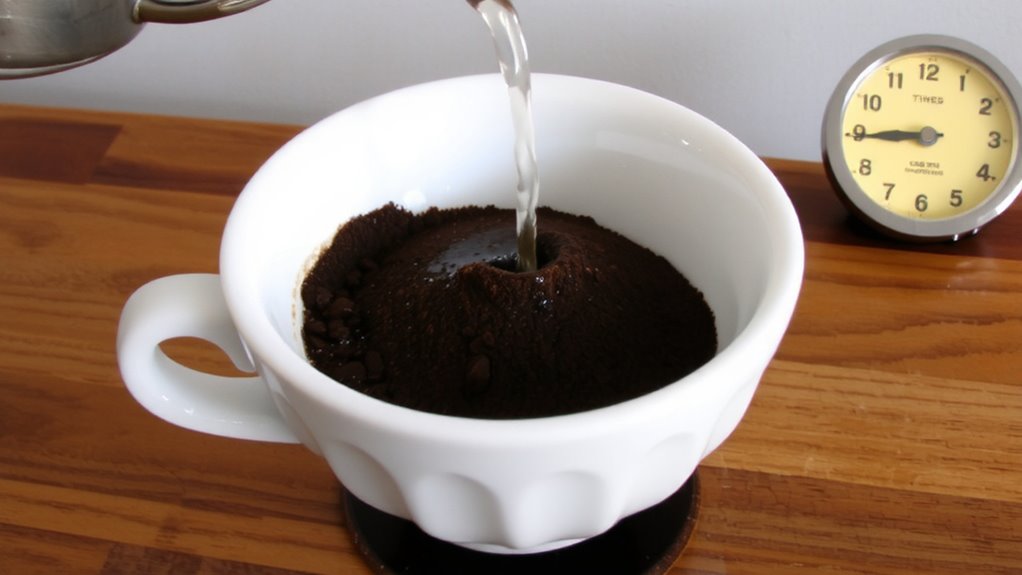
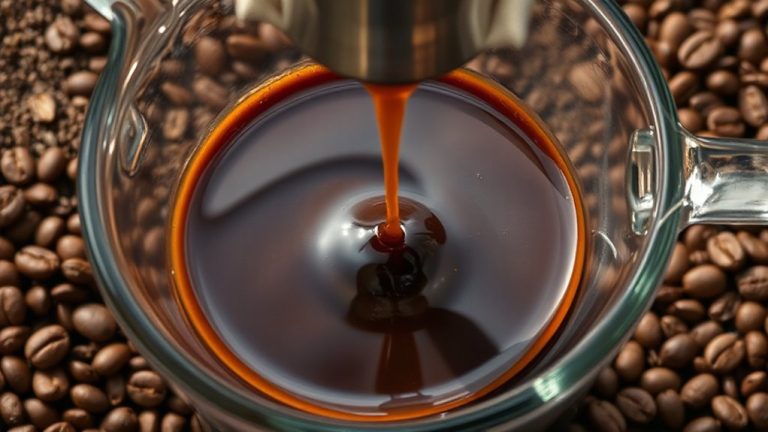
Think of pre-wetting as the warm-up before the main event-it’s when you briefly wet your coffee grounds with a small amount of water before starting the full brew. You let them bloom for 30 to 45 seconds, releasing trapped CO₂, which helps water flow evenly later. This step matters because uneven wetting can lead to under-extracted, sour coffee. The historical origins of pre-wetting trace back to manual pour-over methods in mid-20th-century Japan and Scandinavia, where precision brewing gained traction. Its cultural significance grew alongside third-wave coffee, emphasizing process and quality. While automatic drip machines often skip this, gooseneck kettles and scales make it easy at home. Skip pre-wetting, and you risk inconsistency-especially with fresh, light-roast beans. Use it when clarity and balance are priorities, not just speed. It’s simple, effective, and backed by practice. A key tool in mastering this technique is using a gooseneck kettle for precise manual coffee brewing methods.
How Does Pre-Wetting Improve Extraction?
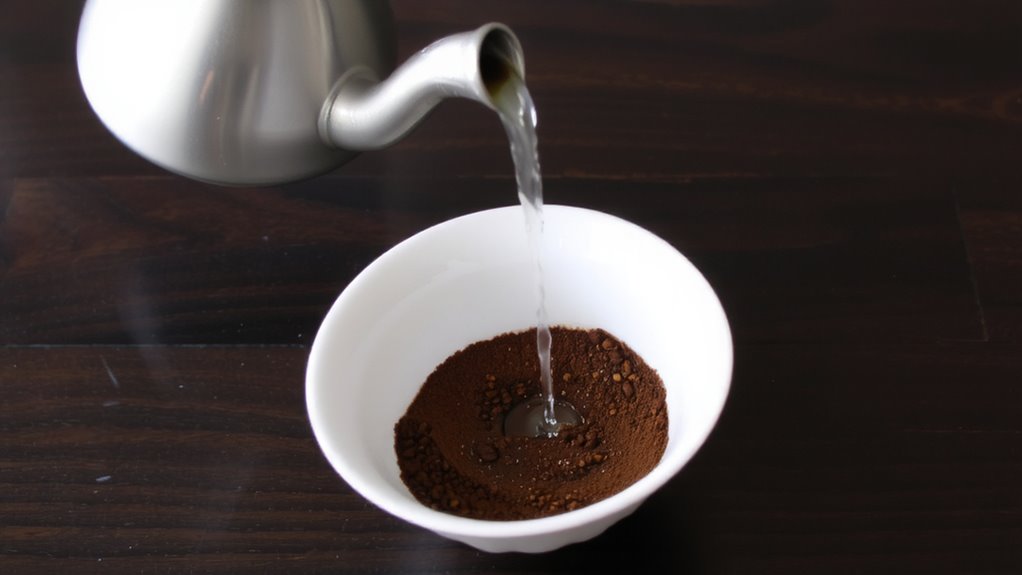
You’ve already seen how pre-wetting prepares your grounds for brewing by releasing trapped CO₂ during bloom, and now it’s time to see how that step directly shapes extraction. Pre-wetting guarantees even coffee expansion, letting water reach all particles uniformly once brewing begins. Without it, dry spots or clumps can form, leading to under-extraction and sour notes. The initial gas release from fresh beans creates resistance, so saturating the bed first reduces channeling, where water takes the path of least resistance. That means more balanced flavor. Light roasts, which hold more CO₂, benefit especially-pre-wetting smooths out their extraction curve. You’ll notice clearer acidity and better sweetness. Skipping pre-wet might save seconds, but you lose control. With pre-wetting, you’re not just wetting-you’re setting the stage for even, predictable extraction, making your brew more consistent and balanced cup after cup.
Can Your Coffee Maker Do Pre-Wetting?
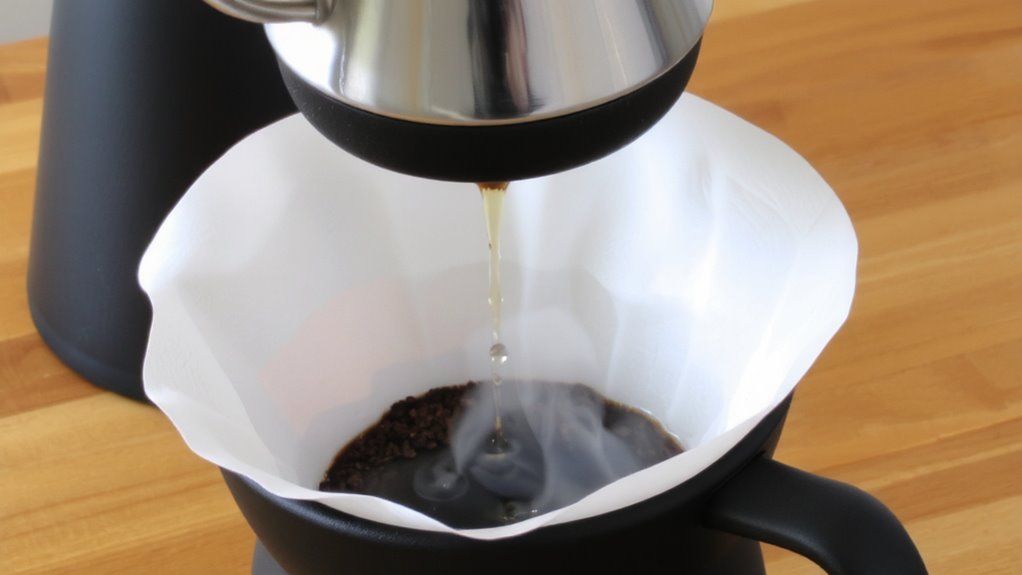
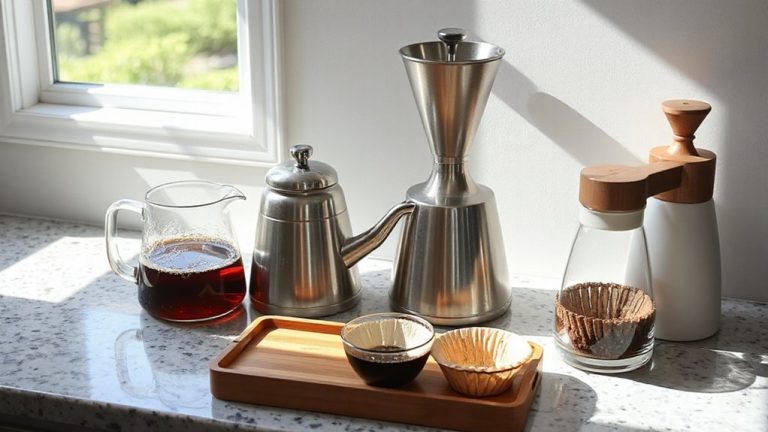
How well does your coffee maker handle pre-wetting? Most standard drip machines don’t support it out of the box, leaving you to rely on manual control. Higher-end models like the Technivorm Moccamaster or certain Breville machines offer a pre-wetting or blooming function, giving you better extraction with little effort. If your machine lacks this feature, you can pause the brew cycle after 30 seconds to let the grounds bloom-just make sure the model allows pausing without damage. Machine compatibility is key: not all brewers can safely handle interruptions. For full manual control, consider switching to pour-over methods like the Chemex or V60, where you manage the entire pre-wet phase. These options give consistent results and adapt easily to different beans and roast levels. Always check your machine’s manual to confirm its capabilities. Top models from Seattle coffee machines often include advanced blooming features for optimal flavor development.
How Long Should You Pre-Wet Coffee Grounds?
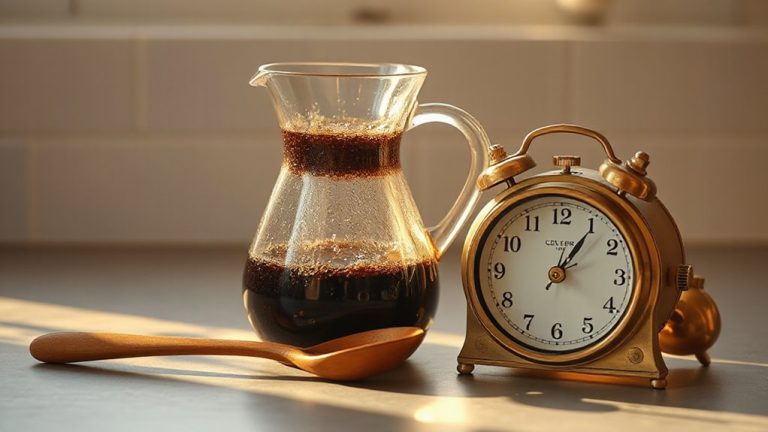
A good pre-wet starts with timing-most coffee makers that support blooming do it automatically in the first 30 to 45 seconds, but if you’re handling it manually, aim for a full 30 seconds of saturation before continuing the brew. This short wait lets trapped CO₂ escape, which helps water penetrate evenly. Water temperature matters: use 195–205°F to optimize extraction without scalding. Too hot, and you risk bitterness; too cool, and your coffee tastes flat. Grind consistency also affects timing-uniform particles bloom evenly, while uneven grounds cause pockets of under- or over-extraction. For precise control during manual pre-wetting, consider using a coffee syringe to evenly saturate the coffee bed.
| Brew Method | Pre-Wet Time | Ideal Grind |
|---|---|---|
| Pour-Over | 30 sec | Medium-fine |
| Auto Drip | 45 sec | Medium |
| French Press | 30 sec | Coarse |
| AeroPress | 20–30 sec | Fine to medium |
How Much Water Should You Use to Pre-Wet?
About a quarter to a third of your total brew water is all you need for an effective pre-wet, and that’s usually enough to fully saturate the grounds without washing away soluble flavors. You’re not trying to extract-just prepare. Use water temperature between 195°F and 205°F, the same as your main brew, to guarantee even blooming and prevent channeling. Too much water and you risk early extraction; too little leaves dry pockets. Your grind consistency plays a key role-uniform particles absorb water evenly, so a burr grinder is better than a blade. If your grind is too fine, even the right water amount may cause dripping too fast or overflow. Coarser grinds may need a slightly fuller pre-wet to saturate fully. Aim for a wet but not soupy bed. With consistent gear and ratios, you’ll improve control, shot after shot.
Fixing Under- and Over-Extraction From Poor Pre-Wetting
If you’re seeing weak or sour coffee, chances are your pre-wet isn’t doing its job-under-wetting leaves dry spots that lead to uneven extraction, while over-wetting kicks off full extraction too soon, especially in the center of the bed. Poor grind uniformity worsens this, as inconsistent particles absorb water unevenly. A burr grinder helps, but even small gaps in particle size can create extraction flaws. Water temperature variance between 195°F and 205°F matters, too-going too low slows extraction; too high risks scalding fines. Use a gooseneck kettle with a thermometer or temperature control to minimize swings. For ideal pre-wetting, aim for saturation just under 30 seconds, allowing even bloom without premature runoff. Adjust grind size first, then tweak pre-wet duration and water volume. This reduces channeling and guarantees even extraction across the bed, especially with medium to medium-fine grinds common in drip brewing.
Adjust Pre-Wet for Roast and Bean Type
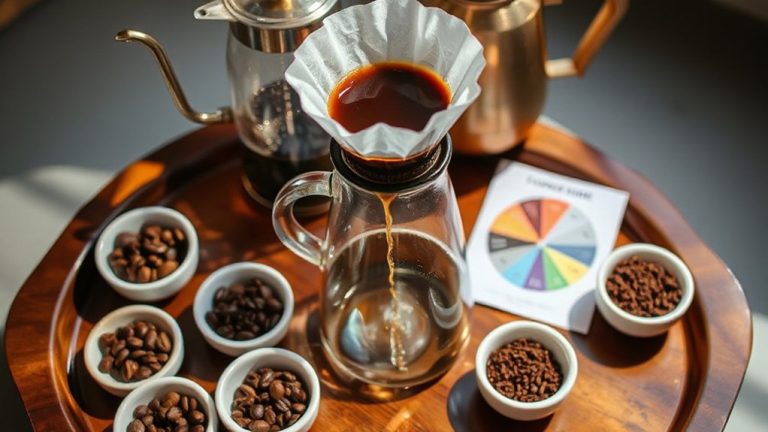
Since lighter roasts tend to be denser and retain more gas, you’ll need a longer pre-wet-closer to 30 seconds-to guarantee full saturation and a consistent bloom, while darker roasts, which are more porous and degassed, often respond better to a shorter pre-wet of 15–20 seconds to avoid over-extraction. Bean density plays a big role here-denser beans from high altitudes, like many Ethiopians, resist water absorption, so they need that extra pre-wet time. Older beans, past peak roast age, lose moisture and gas, so even a light roast that’s a few weeks old may not need as long a pre-wet. Adjust accordingly. If your coffee tastes flat or bitter, check both roast age and bean density before tweaking grind size. Freshness matters: aim to brew lighter roasts within 7–14 days of roast date, and darker ones within 3–10. Your pre-wet should match the bean’s physical state, not just its roast level.
On a final note
You now know pre-wetting helps even extraction by letting coffee bloom before full brewing. Use 10% of your total water, just off-boil, and wait 30–45 seconds. It works in pour-over or batch brewers with a pre-infusion setting, like the Fellow Ode or Moccamaster KBGV. Skip it only if pressed for time-otherwise, it’s a small step that fixes common under- or over-extraction issues, especially with fresh or dense beans.